What Is Ahrefs and How Dev Agencies Use It in 2026
What is Ahrefs for dev agencies in 2026? A direct explainer of features, AI visibility tools, pricing, and workflows that turn SEO into pipeline.
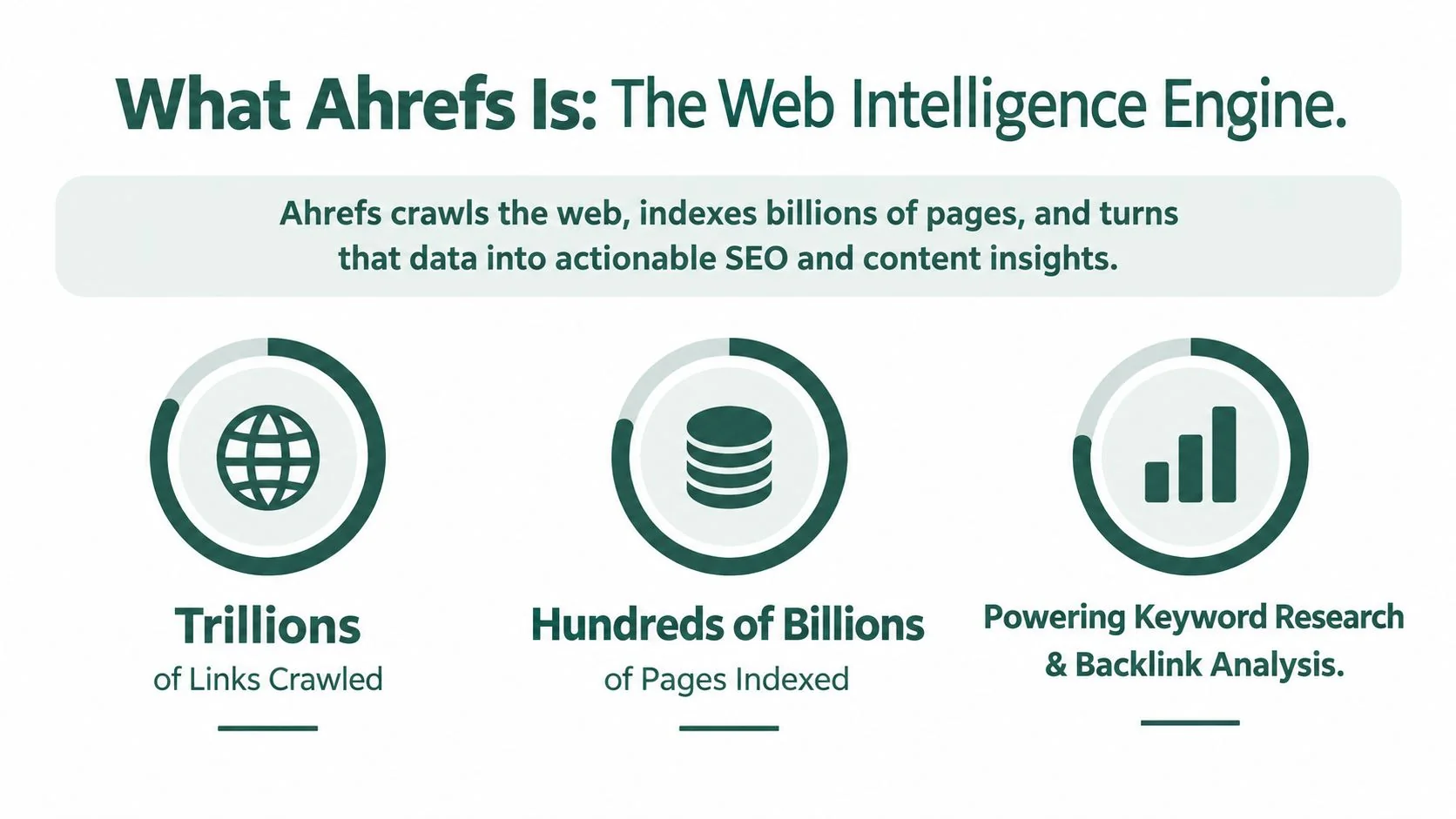
Ahrefs is a bootstrapped web-intelligence platform that crawls 35 trillion live backlinks and indexes hundreds of billions of pages to power keyword research, backlink analysis, rank tracking, content discovery, and increasingly AI-mention monitoring. It’s not merely a backlink checker. For a software development agency, Ahrefs is a system for deciding which niche to own, which competitors to displace, and whether buyers can find or recognize you before an RFP arrives.
The counterintuitive point is that Ahrefs’ value isn’t its dashboard. It’s the scale and freshness of the underlying data. Ahrefs says its crawler runs continuously and maintains a database spanning 35 trillion live backlinks and 22 billion pages on Site Explorer, while Keywords Explorer contains 28.7 billion filtered keywords from 110 billion discovered keywords (Ahrefs Site Explorer, Ahrefs Keywords Explorer).
What Ahrefs Actually Is and Why It Matters for Dev Agencies
Ahrefs is a web-intelligence platform built around crawling, indexing, and interpreting relationships between websites, links, keywords, and search visibility. Its own data architecture combines first-party crawling from AhrefsBot and AhrefsSiteAudit with keyword sources including Google Keyword Planner, Google Trends, and Google Search Console (Ahrefs Big Data, Ahrefs FAQ).
That scale matters because a 100 to 500 person development agency rarely loses a deal because prospects doubt its ability to write code. It loses because another firm already owns the category language. The competitor appears for “fintech software development company,” gets cited in comparison content, and becomes familiar before procurement starts.
Ahrefs lets a demand-generation team inspect that market rather than guess at it. Site Explorer shows which pages attract links and organic visibility. Keywords Explorer reveals whether a service line has meaningful search demand and which topics belong together. Content Gap shows where competitors have visibility the agency lacks. Those outputs become positioning decisions, editorial priorities, and outreach targets.
Ahrefs’ business history reinforces why serious teams take the platform seriously. It was founded in 2010 by Dmitry Gerasimenko and is widely described as bootstrapped, starting with about $300,000 of personal funds and reaching roughly $1 million in revenue by 2011, $12 million by 2016, $37 million by 2018, and around $65 million by 2020. Independent estimates placed revenue near or above $100 million in annual recurring revenue by 2021, with a later estimate of about $149.1 million in 2024 (Quantumrun profile of Ahrefs).
Practical rule: Use Ahrefs to make a niche decision before you use it to make a content decision.
Ahrefs is most useful when it connects market intelligence to commercial execution. A team can map a vertical, identify bottom-funnel queries, find the pages influencing that market, and give sales a more credible reason to contact named accounts. For broader context on this type of agency growth system, the 100Signals resource page for agencies is a relevant reference. If your priority is specifically AI visibility rather than classic search data, compare Ahrefs with a better AI SEO tool than Ahrefs before committing.
The Core Features That Drive an Agency SEO Workflow
Ahrefs earns its place in a dev agency’s stack only when it produces a decision tied to pipeline or niche ownership. Treat the modules as a workflow, not a catalogue of equally valuable features.
The feature-to-output map
| Feature | Primary Agency Job | Typical Output |
|---|---|---|
| Site Explorer | Competitor teardown and link prospecting | Competitor pages, referring domains, anchor patterns, link targets |
| Keywords Explorer | Niche validation and topic planning | Service keywords, parent topics, intent groups, opportunity brief |
| Site Audit | Technical SEO delivery | Prioritized crawl issues, internal-link opportunities, implementation tickets |
| Content Explorer | Content and outreach research | High-performing pages, authors, publications, prospect lists |
| Rank Tracker | Pipeline visibility | Keyword movement by service line, market, device, and funnel stage |
| Alerts | Market monitoring | New backlinks, mentions, and significant ranking changes |
| API | Internal reporting and analysis | Data feeds for dashboards, BI, and account-level intelligence |
Site Explorer should come first. Use it to examine the strongest organic competitors for a target service. Review their top pages, referring domains, anchor text, and organic keywords. The useful question is not how many backlinks they have. It is why buyers shortlist them while your agency remains absent from the conversation. That answer can shape positioning, proof assets, partnership targets, and outreach.
Keywords Explorer validates the niche before the editorial calendar. Ahrefs says its database includes 2.7 billion US keywords and roughly 29 billion keywords overall (Ahrefs Keywords Explorer). Use parent topics to combine close variants into authoritative resources instead of commissioning several thin pages. For a software agency, the output should be a service-line map tied to buyer intent, including discovery, modernization, cloud migration, and regulated-product engineering.
Site Audit supports delivery after the opportunity is clear. It identifies crawl problems, broken pages, orphan pages, internal-link gaps, and other obstacles that keep valuable content from being found. Give engineers an exportable queue with owners, severity, URLs, and acceptance criteria. A generic health score is not an implementation plan.
Content Explorer has a narrower role. Use it to find pages that already attract links or attention in a selected niche, then identify relevant publications and authors for a defined campaign. Skip it until the agency has editorial capacity and a named outreach owner. Research without a person responsible for execution will not shorten a sales cycle or establish category ownership.
Rank Tracker turns SEO into an operating measure. Segment terms by service line and funnel stage, then review movement with sales. A change matters more when it affects “hire,” “company,” “partner,” or implementation queries than when it affects an educational term with no clear path to a conversation.
Alerts provide practical market monitoring. New competitor backlinks can expose partnerships and publications. New mentions can create relationship opportunities. Significant keyword movement can indicate an opening to pursue or a content problem to fix.
The API belongs in a later phase. Use it when the agency has a defined reporting model and needs structured feeds for dashboards, business intelligence, or account-level analysis. Automation cannot compensate for unclear decisions, so define the dashboard’s required actions before paying for API access.
Ahrefs as an AI Visibility Platform, Not Just a Backlink Tool
Ahrefs now matters as an AI-visibility and competitive-intelligence platform, not merely a backlink database. Its Brand Radar expansion covers Claude, Grok, and entity-based matching, alongside conventional search intelligence (Ahrefs product updates). For a 100-500 person software development agency, the relevant question is whether that visibility shortens sales cycles or helps the firm own a profitable niche.
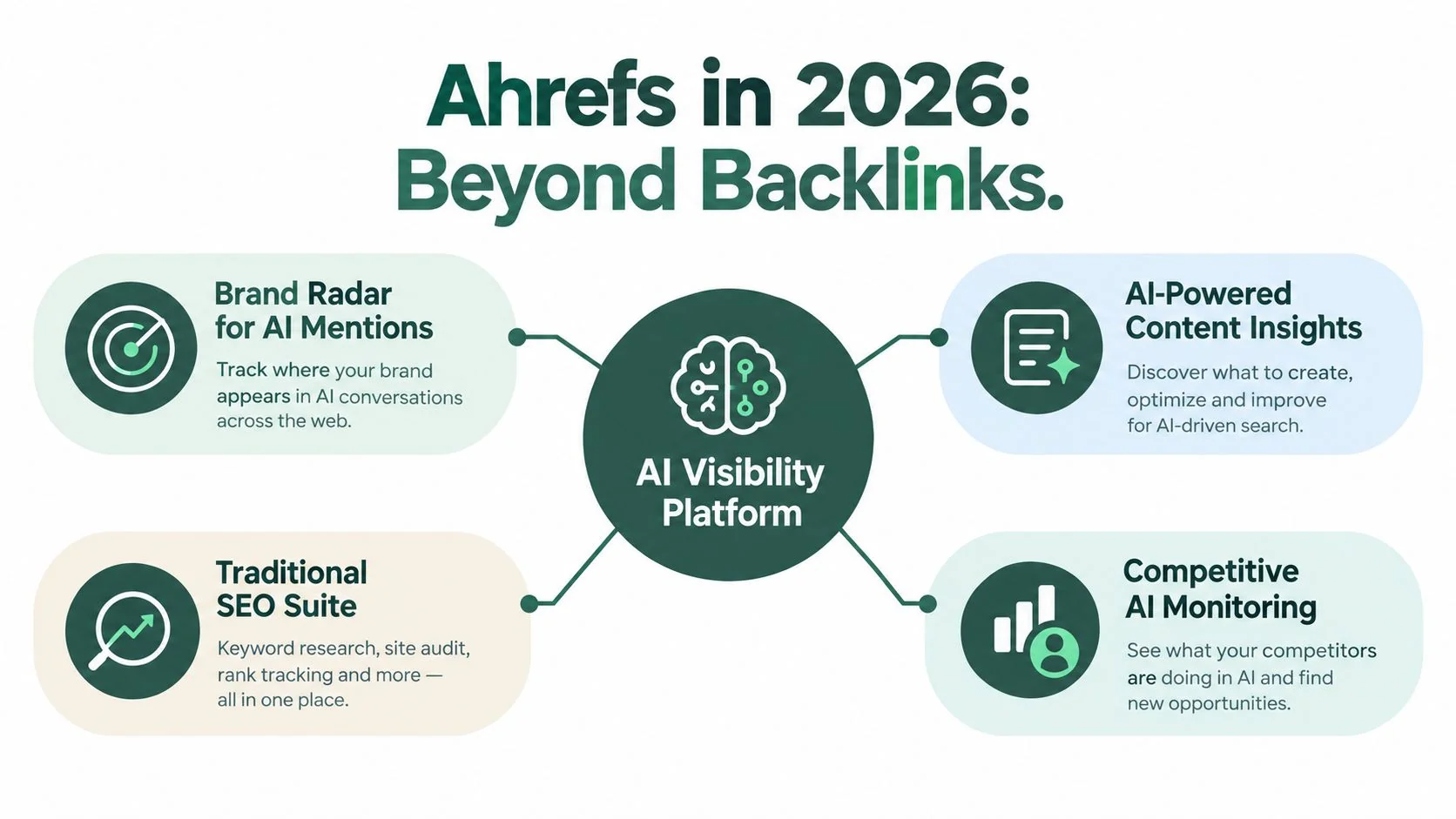
Ahrefs reported that Brand Radar’s prompt dataset grew from about 14 million to 30 million prompts in August 2026. That scale makes the agency use case concrete. A firm selling fintech engineering should check whether AI assistants mention it when buyers seek fintech product teams, regulated-platform specialists, or alternatives to named competitors.
AI visibility measures a different outcome from traditional rank tracking. Google rankings show where a page appears in results. AI monitoring shows whether the brand appears in an answer, which competitors appear beside it, which entities the system associates with the niche, and which sources support those answers.
An agency that audits AI mentions with the same discipline it applies to referring domains gets an earlier view of category ownership.
Brand Radar’s coverage of ChatGPT, Claude, Perplexity, Gemini, Grok, and related AI answer environments gives demand-generation leaders a practical monitoring layer. It does not replace Google SEO. Traditional search visibility still supplies much of the source material AI systems use, so monitor both channels together.
Use AI search monitoring tools to compare requirements before buying another platform. The 100Signals AI visibility guide provides additional context for evaluating whether AI assistants cite the agency’s niche and competitors.
The commercial test is direct. If AI assistants repeatedly recommend competitors for the categories sales targets, Brand Radar can expose a positioning or authority gap worth fixing. If pipeline comes almost entirely from existing relationships, this feature is overkill for now. Prioritize it when niche ownership and shorter evaluation cycles are active growth goals.
Five Workflows Dev Agencies Run on Ahrefs Every Week
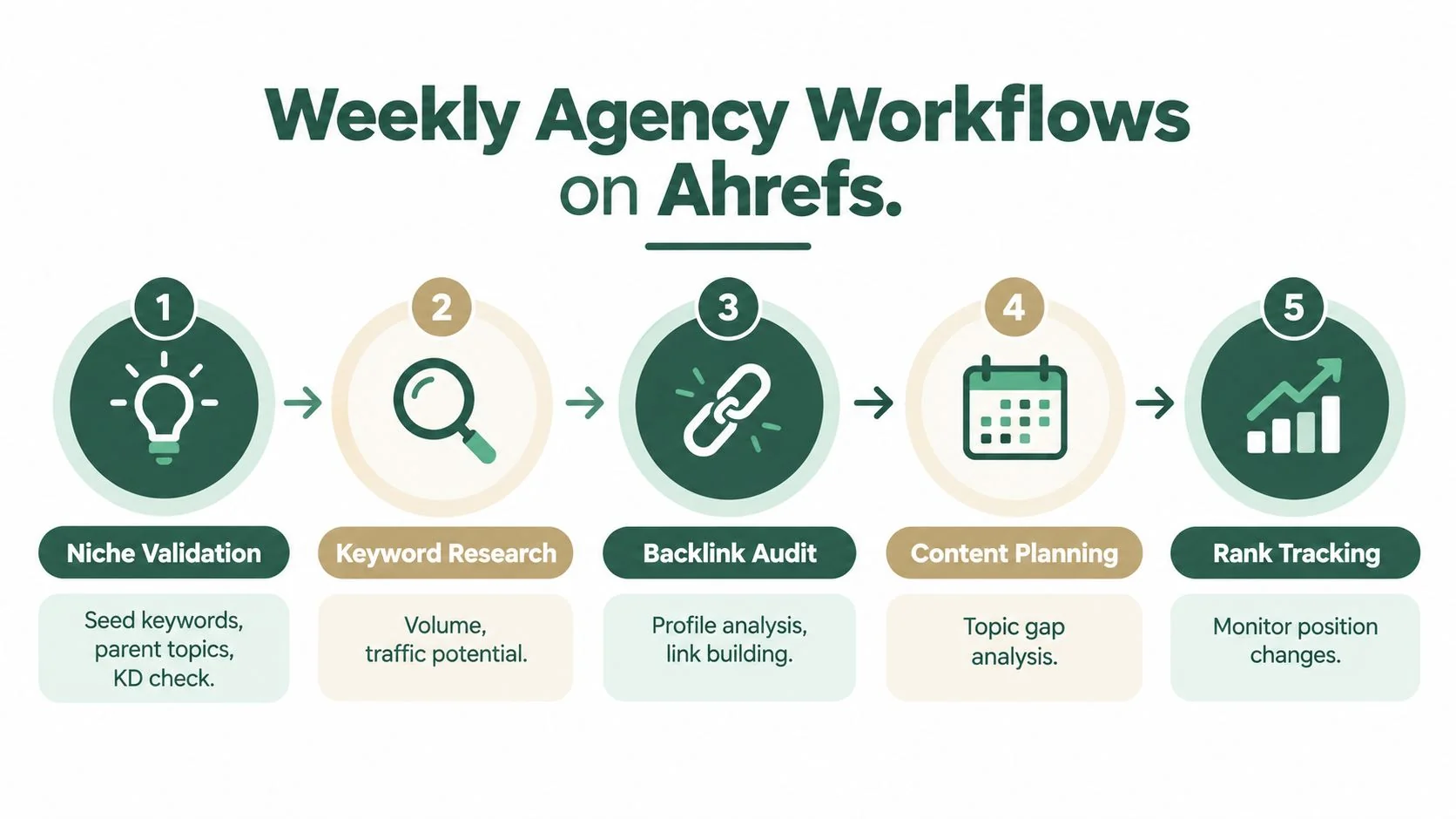
Ahrefs earns its subscription when the team converts reports into decisions. These five workflows give a demand-generation manager a repeatable operating rhythm.
Niche validation
Start in Keywords Explorer with a service term and several buyer-language variations. Review keyword intent, difficulty, traffic potential, and parent topics, then save the terms that represent a real commercial problem rather than generic technical curiosity.
The deliverable is a niche brief. It should state which services have search demand, which queries indicate buying intent, which topics require separate pages, and where the agency has a credible right to compete. If the brief can’t support a clear positioning decision, don’t commission the content yet.
Competitive research
Open Site Explorer for the closest organic competitors, not just the largest firms in the market. Inspect their top pages, referring domains, organic keywords, and traffic-driving content.
The output should be an opportunity map. Identify pages that attract authority, topics where competitors rank without strong relevance, and publications that repeatedly cover the category. A marketing lead can use that map to prioritize content and partnership work instead of asking writers to “publish more.”
Content gap analysis
Use the Content Gap report with two or three competitor domains. Filter results by intent and business relevance, then group related terms under parent topics.
This workflow should produce a production backlog with a page type, target service, buyer stage, internal subject-matter expert, and next action. Don’t turn every missing keyword into a page. Several terms may describe one buyer question, and one strong page can serve that cluster better than a set of near-duplicates.
Link prospecting
In Site Explorer, open the referring-domains and referring-pages reports for competitor assets. Filter prospects using authority and relevance, then remove directories, irrelevant publishers, and sites with no plausible editorial relationship.
The useful output is an outreach sheet with the target page, why the agency is relevant, the asset or expertise it can contribute, and the person responsible for contact. A backlink list without a reason to engage is not a pipeline asset.
Rank tracking
Set up Rank Tracker around service lines and funnel stages. Tag terms as category, problem, solution, comparison, or vendor intent. Review movement with sales so a commercial ranking improvement triggers account research, while an informational gain feeds retargeting or nurture.
Use this video as a visual complement to the workflow:
The weekly meeting should discuss decisions, not dashboard tourism. Which page gets improved, which competitor becomes an outreach target, which service line needs proof, and which ranking change changes account priority?
Getting Started in Your First Week on Ahrefs
A marketing lead can establish a useful operating baseline in five working days, provided every report has a sales or delivery decision attached.
Day one, configure the workspace. Add the agency domain and two or three credible organic competitors as projects. Confirm crawl access for Site Audit, then define the service lines and markets that matter to pipeline.
Day two, run Site Audit. Export only prioritized issues and assign them to the engineering sprint board. Start with broken and orphan pages, blocked important resources, and internal-link problems affecting strategic pages. Developers need a ranked worklist, not an undifferentiated export.
Day three, research demand. Put three service-line terms into Keywords Explorer. Save parent-topic groups, mark commercial queries, and create the first Rank Tracker list. Separate language sales uses from terminology limited to practitioners.
Day four, inspect a competitor. Open Site Explorer for the closest organic rival. Review referring pages and domains, then record relevant prospects in an outreach sheet. The goal is to identify third parties already validating the category and decide which niche proof your agency still needs.
Day five, configure Alerts. Track brand mentions, new competitor backlinks, and meaningful keyword drops. Give sales read-only access when appropriate, so account teams can see emerging market conversations and connect them to active opportunities.
Credit discipline: Batch deep audits monthly, export only rows people will act on, and do not refresh exploratory reports without a decision attached.
Assign one owner to report consumption. Starter plans are capped at 200 credits per month and can’t purchase extra credits or users. Set a shared reporting calendar before several people run the same exploratory reports. That discipline keeps Ahrefs focused on shortening sales cycles and building niche ownership, rather than producing dashboards nobody uses.
Pricing, Plans, and Which Tier a Dev Agency Should Buy
Ahrefs’ current paid plans are $129 per month for Standard, $249 per month for Advanced, and $1,499 per month for Enterprise, according to its pricing page. The brief calls the first comparison tier “Lite,” but the current plan names should guide the purchase.
| Feature | Lite $129/mo | Standard $249/mo | Advanced $1,499/mo |
|---|---|---|---|
| Monthly price | $129 | $249 | $1,499 |
| Best fit | Single-niche validation | Active agency SEO program | Multi-property, data-heavy operation |
| Rank and reporting workload | Limited | More suitable for recurring reporting | Built for substantial scale |
| Credit headroom | Lower | Practical starting point | High-volume use case |
| Agency recommendation | Trial only | Default choice | Upgrade when scale demands it |
For a 100 to 500 person software development agency, Standard at $249 per month is the default choice once leadership commits to niche ownership. It supports recurring keyword tracking, competitor analysis, content-gap research, and technical reporting without imposing an enterprise-level operating model. Those workflows matter because they can shorten sales cycles and build the evidence needed to win specialized buyers.
Use the lower tier only while validating one niche and one publishing motion. Move up after the team has a working content backlog, a defined reporting cadence, and an owner responsible for converting findings into outreach or sales follow-up.
Advanced fits agencies managing multiple regions, several client or business properties, or data-heavy internal reporting. Ahrefs documentation says Looker Studio connectors require Advanced or higher, so that upgrade makes sense only when an established reporting process depends on those connectors (Ahrefs Looker Studio connector documentation).
Do not buy Advanced for prestige. Buy it when the lower plan creates a named operational bottleneck, such as reporting across properties or supporting a larger data workflow. If the agency cannot identify that constraint, Standard is the better allocation of budget.
When Ahrefs Is Worth It and When It Is Overkill
Ahrefs earns its seat when the agency’s growth strategy depends on becoming visible before a buyer has chosen a shortlist. That usually means a competitive technical niche, a consistent content program, meaningful competitor monitoring, or a need to understand whether AI assistants associate the agency with the right category.
It’s particularly useful for firms targeting fintech, healthtech, devtooling, cloud modernization, or other categories where authority and proof shape the buying process. Site Explorer helps identify the pages and publishers that influence the niche. Keywords Explorer helps build a service architecture around buyer language. Brand Radar adds an AI-mention layer for prospects who increasingly use assistants to create vendor shortlists.
The decision matrix
| Agency Profile | Worth It or Overkill | Key Reason |
|---|---|---|
| Targets competitive technical niches | Worth it | Competitor authority and topic gaps need dedicated intelligence |
| Publishes consistently for demand generation | Worth it | The team can convert research into a recurring editorial system |
| Tracks AI mentions and competitor positioning | Worth it | Brand Radar extends monitoring beyond traditional rankings |
| Relies almost entirely on referrals | Overkill | The data won’t influence the primary acquisition channel |
| Targets narrow, low-demand long-tail terms | Often overkill | Google Search Console may answer the basic visibility question |
| Produces little content | Overkill | Research depth has no value without implementation capacity |
| Needs complex internal dashboards | Worth it at the right tier | API and connector access matter only with a defined reporting process |
The strongest buying signal is not company size. It’s whether someone owns the loop from insight to execution. A 200-person agency with no content owner will waste Ahrefs. A smaller specialist team with a clear niche, technical expertise, and disciplined outreach can turn the same data into authority.
For agencies whose needs are limited to first-party performance data, it makes sense to compare GSC archival tools before paying for a broader intelligence platform. Google Search Console can answer what your own site already earns, but it won’t replace competitor link analysis, market-wide content discovery, or cross-brand visibility monitoring.
CEO test: If the team can’t name the niche, the decision-maker, and the weekly action Ahrefs will trigger, don’t purchase it yet.
Ahrefs is overkill for a referral-only firm, a team that publishes sporadically, or an agency that wants a report without changing its positioning. It earns its cost when the output becomes commercial: a page that supports a target service, a publisher relationship that validates the niche, a competitor gap that creates an account-opening reason, or an AI visibility problem that changes the authority plan.
For a software development agency, the decision is therefore about niche ownership and pipeline access, not software completeness. Buy Ahrefs when search and AI visibility are part of how you intend to enter accounts. Use the Standard plan as the default, build one measurable workflow around a chosen vertical, and make every report answer a sales question. That is how the platform moves from an SEO expense to competitive infrastructure.
If your agency has a target niche but no clear view of its search competitors or AI visibility, request a free 100Signals positioning scan. It will help identify what AI assistants cite for the niche, what your homepage currently claims, and which competitors appear instead, giving your team a concrete starting point for niche authority and pipeline planning.