Niche Rankings That Actually Build Pipeline
Niche rankings for software development agencies: a scoring framework, content plays, and measurement steps that turn one niche into qualified pipeline.
The popular advice is wrong: niche rankings aren’t a contest to capture the largest keyword. For a software development agency, the valuable territory is usually a narrow set of problem-shaped searches connected to a real buying decision, then the surrounding answers that Google and AI assistants can associate with your agency. A defensible niche should therefore be scored on winnability, commercial intent, and AI citation potential, with demand size and scope completing the decision.
Why Most Niche Rankings Advice Fails Dev Agencies
Most agencies still choose a niche by sorting keywords by monthly search volume, copying a competitor’s top pages, and treating a first-place ranking as the finish line. That process produces traffic reports, not necessarily qualified conversations. A category term can attract researchers, students, vendors, and people looking for free documentation while a smaller query such as a migration problem or compliance requirement reaches someone who can sign a development contract.
The second failure is treating a niche ranking as a single-page achievement. A page that ranks without adjacent authority is easy for a new entrant to displace. Buyers ask follow-up questions about architecture, implementation risk, integrations, cost, timelines, and vendor fit. Your agency needs useful answers across that sequence, not one optimized landing page surrounded by generic blog posts.
The click economics support a top-heavy strategy, but they don’t justify chasing volume. One large CTR study reported an average 18.20% CTR for position 1 and 10.05% for position 2 (DigitalRelevance CTR study). Another benchmark cited in the same market found 27.6% CTR for the first result and about ten times more clicks than position 10. The practical conclusion is simple: moving a commercially relevant query from positions three to five into the top two can matter more than moving a high-volume query from the bottom of page one into the middle.
The operating question isn’t “How much traffic can this niche generate?” It’s “Can we own the buyer’s decision path before another agency does?”
That requires a territory model. Demand size measures qualified demand, winnability measures whether your current authority can break into the top results, and AI citation potential measures whether assistants select your material when buyers ask who can solve a specific problem. Commercial intent and outbound reach determine whether visibility becomes pipeline. For broader context on identifying underserved opportunities, oportunidades B2B para consultoras is useful because it treats market selection as a business decision rather than a keyword exercise.
What Niche Rankings Mean for a Dev Agency
Niche rankings are a defensible-territory score, not a conventional position report. They measure whether an agency can secure a focused set of search results and AI citations, then turn that visibility into named-account activity and pipeline.
Score four operating inputs before commissioning content.
Demand size
Count qualified queries, not every impression. Include searches that signal a real buyer problem, such as replatforming, legacy modernization, regulated integrations, or a specific technology decision. Exclude broad educational terms unless they connect directly to a service page or sales conversation.
Winnability
Inspect the current search results. Record which pages hold the top positions, whether they come from specialist agencies or broad publishers, how much relevant authority they have, and whether they answer the query cleanly. A niche is winnable when your existing expertise, proof, and links can plausibly beat those pages. A keyword tool’s difficulty score is only one input.
AI citation potential
Run buyer-shaped questions through ChatGPT, Claude, and Perplexity. Ask who builds the solution, which implementation risks matter, which vendors appear credible, and how competing tools compare. AI assistants do not closely mirror traditional rankings. A 2025 study across 15,000 prompts found that only 12% of URLs cited by ChatGPT, Gemini, and Copilot also ranked in Google’s top 10 for the same prompt, with 11% average overlap between AI citations and Google or Bing top-ten results (Ahrefs AI search overlap study). Your content must earn selection on its own.
Outbound reach
Connect the niche to your CRM, LinkedIn account lists, and previous opportunities. Identify how a ranking can support a message to a named account, a relevant proof point, and a credible call to action. Visibility without a reachable buyer universe will not fill a delivery pipeline.
The resources for software development agencies offer a practical reference for connecting positioning, content, and outbound execution. Run this score before building the library. A polished content system aimed at the wrong market still produces weak sales results.
The Scorecard That Picks a Winnable Niche
Reject any niche that cannot become defensible territory. Start with five candidates, then pull current positions from Google Search Console and your rank tracker. Use Ahrefs or Semrush to examine keyword difficulty and SERP intent. Build 25 buyer-shaped questions for citation audits across ChatGPT, Claude, and Perplexity. Match each candidate against CRM records and LinkedIn data, including industry, technology stack, company size, and buying trigger.
Score every niche from 0 to 10 across five dimensions. Demand and winnability receive the highest weights because an agency needs qualified searches and a credible route into the result set. Commercial intent keeps informational traffic from driving the decision. AI citation potential and outbound reach test whether visibility can become pipeline.
| Dimension | Weight | 0-3 Anchor | 4-7 Anchor | 8-10 Anchor | Worked Score |
|---|---|---|---|---|---|
| Demand size | 0.25 | Few qualified queries or weak buyer fit | Recurring problem queries with some reachable accounts | Broad qualified query pool tied to contractable work | 8 |
| Winnability | 0.25 | Weak specialist coverage and clear authority gap | Mixed results, achievable with focused proof | Specialist competitors dominate the SERP | 8 |
| Commercial intent | 0.20 | Mostly educational searches | Mixed research and vendor evaluation | Strong implementation, pricing, comparison, or vendor queries | 9 |
| AI citation potential | 0.15 | No citations and generic content angle | Occasional citation opportunity | Specific questions, sourceable expertise, clear entity fit | 6 |
| Outbound reach | 0.15 | No clear account list or trigger | Reachable accounts with uneven fit | Named accounts, known stack, and strong reason to contact | 8 |
For Shopify Plus replatforming for DTC apparel brands at 8 to 25M ARR, the weighted calculation is:
(8 × 0.25) + (8 × 0.25) + (9 × 0.20) + (6 × 0.15) + (8 × 0.15) = 7.85 out of 10.
Use three decisions:
| Total score | Decision | Action |
|---|---|---|
| Above 7.5 | Build now | Assign authority, proof, content, and outbound resources |
| 6.0 to 7.4 | Watchlist | Collect stronger evidence or improve the weakest input |
| Below 6.0 | Kill | Don’t fund a dedicated niche program |
A score of six for AI citation potential does not stop this Shopify program because the other inputs are strong. It does identify the first workstream. Publish pages that answer specific replatforming questions, cite authoritative Shopify and commerce sources, and present delivery experience in formats assistants can extract. To expand the initial candidate list, find profitable niches. Let the weighted scorecard, not a generic niche list, decide where the agency invests.
Ranking Content Versus Niche Landing Pages Versus Comparisons
Agencies often publish all three asset types at once and dilute the message. Sequence them according to the buyer’s question. A learning-stage buyer needs a rigorous explanation of the problem. A vendor-validation buyer needs evidence that your team understands the niche. A comparison-stage buyer needs a clear decision between known options.
| Asset Type | Buyer Stage | Primary Goal | Format Signal | Ship When |
|---|---|---|---|---|
| Ranking content | Problem learning | Earn qualified discovery and authority | Detailed guide with original evidence and quotable answers | Buyers are defining the problem |
| Niche landing page | Vendor validation | Convert interest into a qualified conversation | Niche headline, ICP, outcomes, proof, single CTA | Buyers are checking whether you fit |
| Comparison page | Active evaluation | Capture an existing buying decision | Direct tradeoffs, criteria, risks, and alternatives | Buyers compare vendors, tools, or approaches |
Ranking content should answer one expensive question completely. Use named technologies, implementation constraints, source links, and a concise answer block that an AI assistant can reuse. Don’t turn it into a disguised service page.
A landing page needs sharper compression. Name the niche, state who you serve, list concrete outcomes, show relevant proof, and make the next step obvious. Organize the page so a crawler can identify the offer without interpreting a wall of positioning copy.
Comparison pages require discipline. A page targeting a competitor should explain meaningful differences and selection criteria, not publish an unsubstantiated attack. A tool comparison should help the reader decide whether your implementation capability matters more than the software choice itself.
Ship the asset that matches the buyer’s current uncertainty. Don’t publish three formats to make the content calendar look full.
For most agencies, the order is ranking content first, landing page second, and comparison content once search and sales conversations reveal recurring alternatives. Reverse that order only when your CRM already shows active vendor comparison demand.
Building Content That Wins Search and AI Citations
A defensible cluster starts with one pillar page that names the niche, defines the problem, and demonstrates why your agency can solve it. Surround it with six to ten problem-shaped supporting articles, each answering one buyer question and linking back with descriptive anchor text. A narrow content map supports topical authority because search engines can connect related pages instead of seeing isolated posts. SurferSEO’s guide to topical authority describes the same principle, thorough interconnected coverage beats broad, thin publishing.
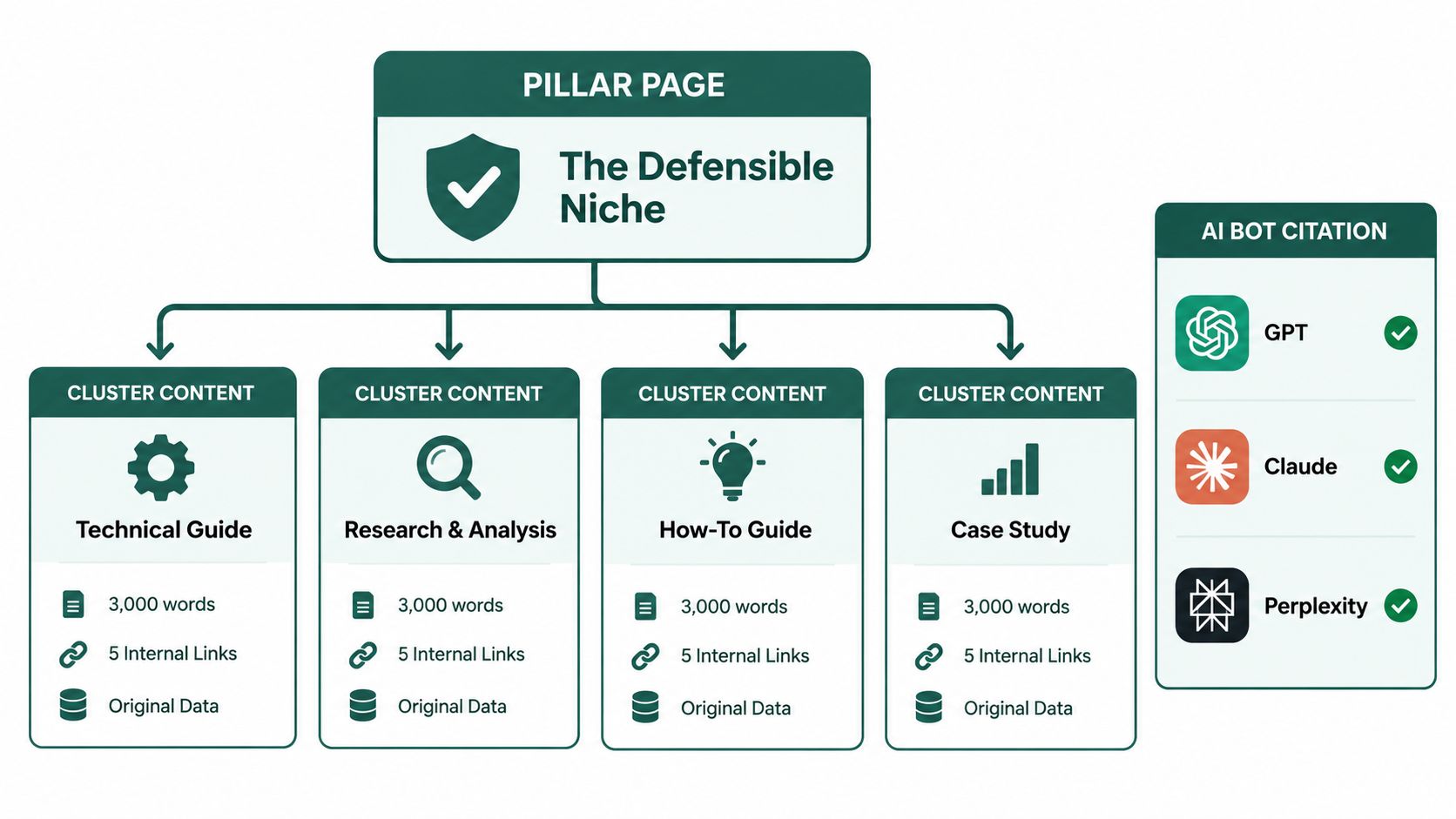
Build every article around an explicit evidence and citation structure:
- Original evidence: Add delivery patterns, architecture decisions, implementation constraints, or anonymized operational observations your team can defend.
- Named sources: Link to official documentation, government material, standards bodies, and recognized technology sources. Replace vague references with sourceable statements.
- AI snapshot: Put a direct answer paragraph near the top. It should define the recommendation, conditions, and main tradeoff without marketing language.
- Structured markup: Use relevant schema where the page type supports it, then make the visible content match the markup.
- Internal links: Point supporting articles to the pillar and to the relevant service page. Link laterally when two questions belong in the same decision path.
The landing page should be tighter than the pillar. Use a niche-specific headline, one ICP line, three concrete outcomes, a proof module, and a single CTA. Don’t force every article to sell. The cluster earns authority by answering the questions buyers ask before they trust the offer.
AI citation auditing should be part of production, not a final check. Ask the same 25 questions after publishing, record which assistants cite your domain, and inspect whether the cited passage answers the question. Understanding how Clara ranks sources can add another perspective to source selection and answer formatting.
Measurement Loop and Kill Thresholds
A niche program needs four measures, each tied to a decision. Track rankings for the five target queries, citation frequency across ChatGPT, Claude, and Perplexity, qualified reply rate from the landing page, and sourced pipeline influenced by the cluster. Keep rank movement separate from business impact. A page can improve its position and still attract the wrong audience.
Use this operating rhythm:
| Metric | Review cadence | Kill threshold | Double-down signal |
|---|---|---|---|
| Target-query rankings | Weekly | Below position 15 after 90 days | Three of five queries reach the top five |
| AI citations | Every two weeks | Zero of three assistants after 120 days | Citations appear consistently in the question set |
| Qualified replies | Rolling 30 days | Below 1.5% | Reply quality and rate clear the agreed benchmark |
| Influenced pipeline | Monthly | Under 10k after six months | Sourced opportunities show repeatable niche fit |
The outbound benchmark gives the reply threshold useful context. The 2026 B2B cold-email benchmark reports an average reply rate of 3.43%, with cold-list sends without intent signals typically at 1% to 2% and signal-triggered sends at 4% to 8% (LeadRiver outbound benchmark). A reply rate below 1.5% doesn’t prove the niche is dead, but it does demand a review of list quality, message fit, proof, and page conversion.
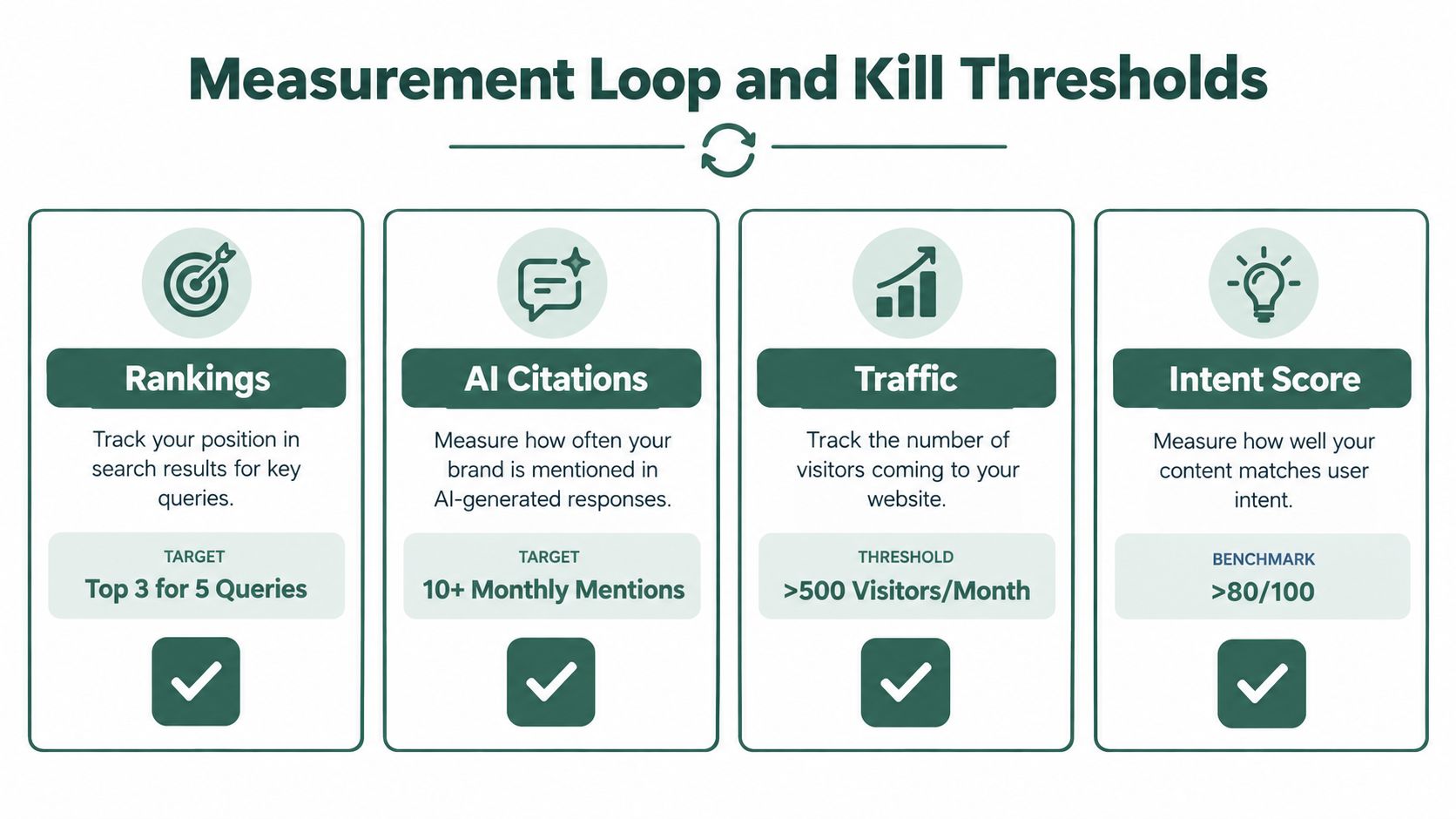
Cut spend when one metric fails in isolation and the root cause is clear. Reassign the niche when the thresholds show structural weakness. Double down when three of four measures clear their thresholds within the same review window.
Two Micro Cases From the 100Signals Benchmarks
The scorecard produces different decisions for different agencies. A small Node shop shouldn’t copy a Rails firm’s positioning, even if both sell custom software. The relevant inputs are the agency’s existing proof, technical depth, buyer access, and ability to produce authoritative answers.
| Input | Case A Node compliance APIs | Case B Rails logistics modernization |
|---|---|---|
| Agency profile | 12-person Node shop | Ruby on Rails agency |
| Initial niche | Compliance APIs for fintech Series A | Custom CRM software |
| Initial score | 78/100 winnability | 41/100 overall |
| Chosen niche | Compliance APIs for fintech Series A | Legacy Rails modernization for logistics |
| New score | AI citation potential was 4/10 | 84/100 overall |
| Content shipped | Six articles and one comparison page | Focused modernization cluster and vendor-oriented content |
| Rank movement | Page three to top three in 14 weeks | Niche rankings improved after repositioning |
| Pipeline result | 11 inbound demos in month four | Two enterprise deals worth $420k within a quarter |
Case A accepted a weak AI citation score because the team had a narrow technical problem, a clear buyer segment, and a reachable fintech account set. The content program used six problem answers and one comparison page to create enough context around the offer.
Case B abandoned a volume trap. “Custom CRM software” described a broad service category with weak differentiation, while legacy Rails modernization for logistics connected a known stack, industry risk, and a specific delivery problem. The score changed because winnability, commercial intent, and outbound impact became stronger together.
The 90 Day Sequence That Turns One Niche Into Pipeline
Run the program in three arcs: validate, defend, activate. The sequence prevents outbound from sending prospects to a page that hasn’t earned trust and prevents content teams from publishing without a commercial destination.
Days 1 to 30, validate. Put five candidate niches through the scorecard. Kill every candidate below 70, select one, outline the cluster, and publish the first ranking-content pillar. Connect the score to CRM evidence, not executive preference.
Days 31 to 60, defend. Publish four supporting articles, one comparison page, and the niche landing page. Track rankings, AI citations, and qualified replies every week. Improve the weakest score dimension instead of adding unrelated topics.
Days 61 to 90, activate. Turn outbound on only after the niche reaches the top five for three pillar queries or produces two AI citations. Route 50 enriched prospects per week to the landing page, keep the account list tied to the niche, and review the kill thresholds before increasing spend.
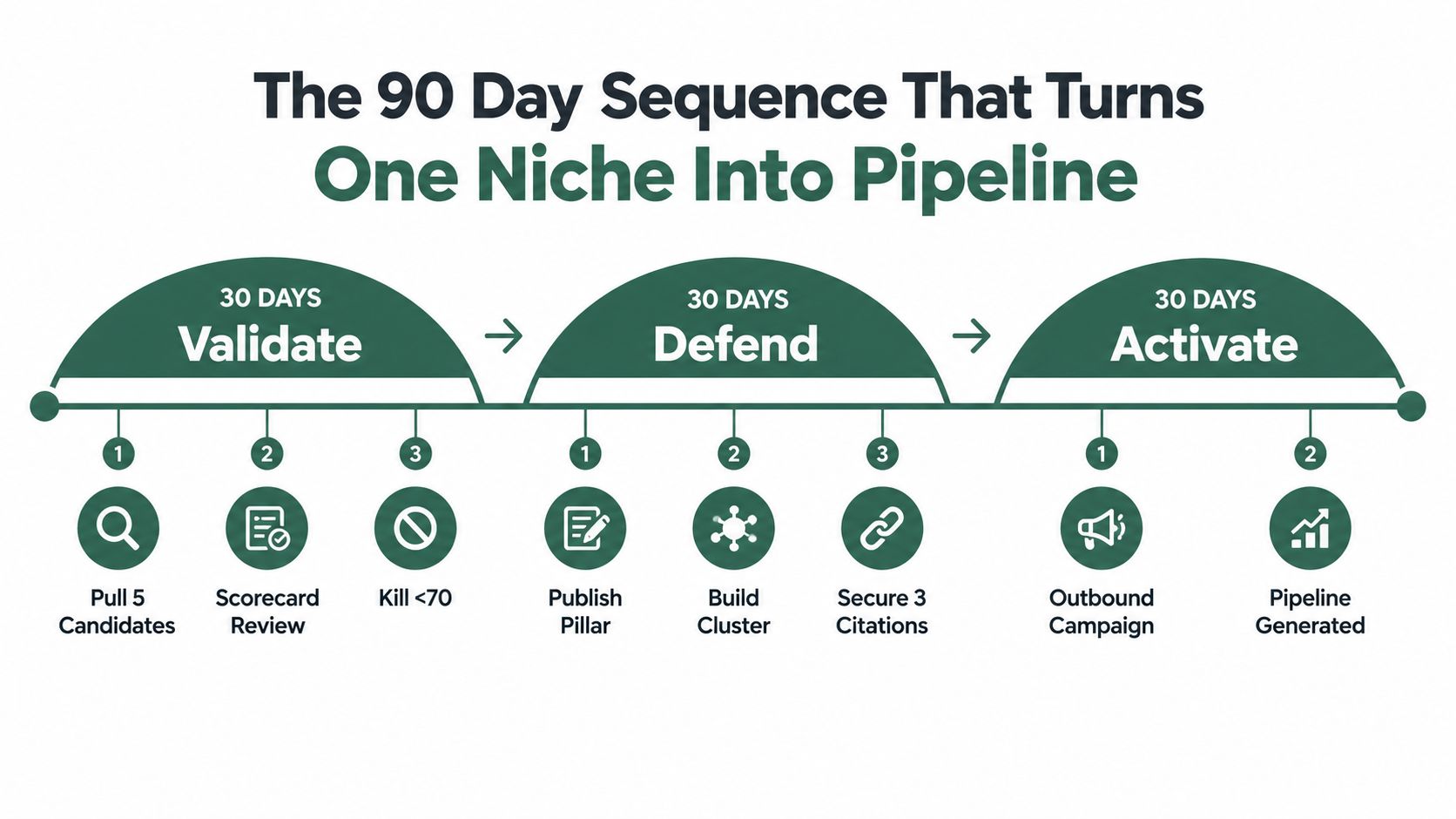
The sequence ends with defended territory, not a content library. 100Signals is one operating option for agencies that want niche validation, authority assets, and outbound activation managed as one system rather than separate SEO and sales projects.
Pick five niches from your CRM and current technical strengths, score them across demand, winnability, commercial intent, AI citation potential, and outbound effectiveness, then commit to one territory for the next 90 days. Build the pillar, supporting answers, landing page, and measurement loop before you ask sales to increase activity. The agency that owns the narrowest credible territory gives buyers fewer reasons to keep comparing vendors, and gives its outbound team a reason to contact accounts that already recognize the problem.