Inbounding and Outbounding: A Dev Agency Playbook
Stop choosing between inbounding and outbounding. This playbook for dev agencies details an integrated 90-day sequence to build authority and convert pipeline.
Most advice on inbounding and outbounding is wrong for a software development agency. It frames the decision as a channel choice. It isn’t. Inbound and outbound are two parts of the same pipeline system, and if you run them as separate motions, you usually get the worst of both. Marketing produces traffic that sales can’t convert. Sales sends outreach that lands on prospects who have never heard of you and have no reason to reply.
The old definitions still matter. Inbound attracts buyers already looking for a solution, while outbound initiates contact with buyers who haven’t raised their hand yet. But the useful question for an agency CEO isn’t “which one wins?” It’s “what sequence lowers friction and raises conversion for the kind of deal we sell?”
Inbounding and outbounding are not competing channels. They are two halves of one pipeline system. Inbound makes your agency recognizable to the accounts outbound is about to contact. Outbound converts that recognition into meetings. Run them in sequence and they reinforce each other. Run them in silos and neither works well. For dev agencies, sequence beats channel choice every time.
Redefining Inbound and Outbound for 2026
Inbound and outbound used to be cleanly separated by who started the interaction. That distinction still holds. Inbound attracts active demand. Outbound creates or captures attention before explicit demand exists. What changed is buyer behavior.
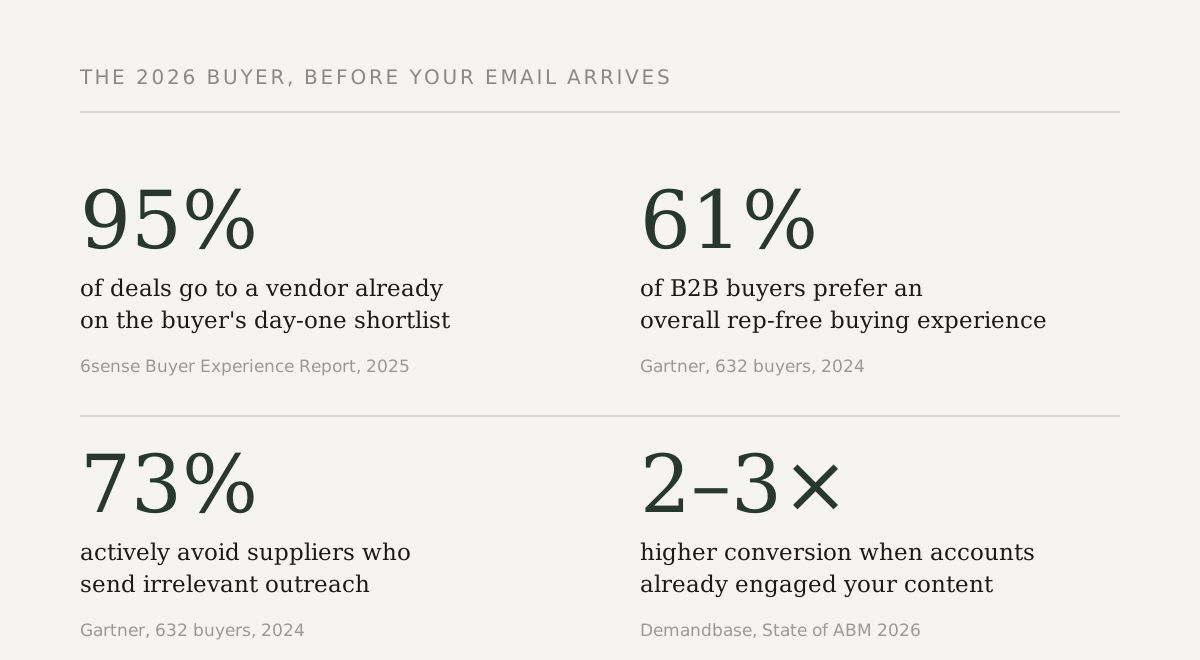
A widely cited B2B benchmark puts SEO and inbound lead close rates at 14.6%, versus 1.7% for traditional outbound-sourced leads. According to Gartner’s 2024 B2B buyer survey (632 buyers, August to September 2024), 61% of buyers prefer a rep-free buying experience. The same survey found that 73% of B2B buyers actively avoid suppliers who send irrelevant outreach. For a dev agency, that doesn’t mean “stop outbound.” It means cold outreach without prior market recognition is structurally disadvantaged. Recognition is what turns outreach from irrelevant to expected.
The picture gets sharper when you look at what happens before the first meeting. According to the 6sense Buyer Experience Report (2025), 95% of B2B deals go to a vendor already on the buyer’s day-one shortlist, and 81% of buyers have a preferred vendor before the first sales call. Demandbase’s State of ABM 2026 report (38 million activities across 1,452 companies) found that accounts that previously engaged with brand content convert at 2 to 3 times the rate of cold accounts. Buyers are already decided by the time they talk to you. The question is whether you’re on their shortlist when they start looking.
If you want a plain-English breakdown of what teams mean by outbound sales for B2B growth, that resource is useful. But the operating mistake most agencies make is taking that outbound definition and treating it like a standalone engine.
Why this matters for niche agencies
A software development agency doesn’t sell an impulse purchase. It sells expertise, delivery credibility, and category fit. Buyers usually inspect your site, search your niche, check LinkedIn, and compare whether your team looks like a specialist or a generic vendor. That behavior makes inbounding and outbounding interdependent.
When a prospect gets your email and then searches your agency, your inbound surface area becomes part of outbound performance. When a prospect finds your technical content first and only later gets a message from your team, outbound becomes a conversion layer, not a discovery mechanism.
Operational view: Treat inbound as the system that makes your name recognizable, and outbound as the system that converts that recognition into meetings.
For agencies trying to build pipeline in a defined niche, this is the real shift. You’re not just trying to “generate leads.” You’re trying to make sure the right accounts can recognize your relevance before a rep asks for time. That’s the gap most generic marketing playbooks miss, and it’s why agency leaders looking at software development lead generation patterns should think in terms of sequencing, not channel silos.
The Recognition-First Mandate for Dev Agencies
The most impactful use of inbound today isn’t raw lead capture. It’s pre-selling your credibility before your team reaches out.
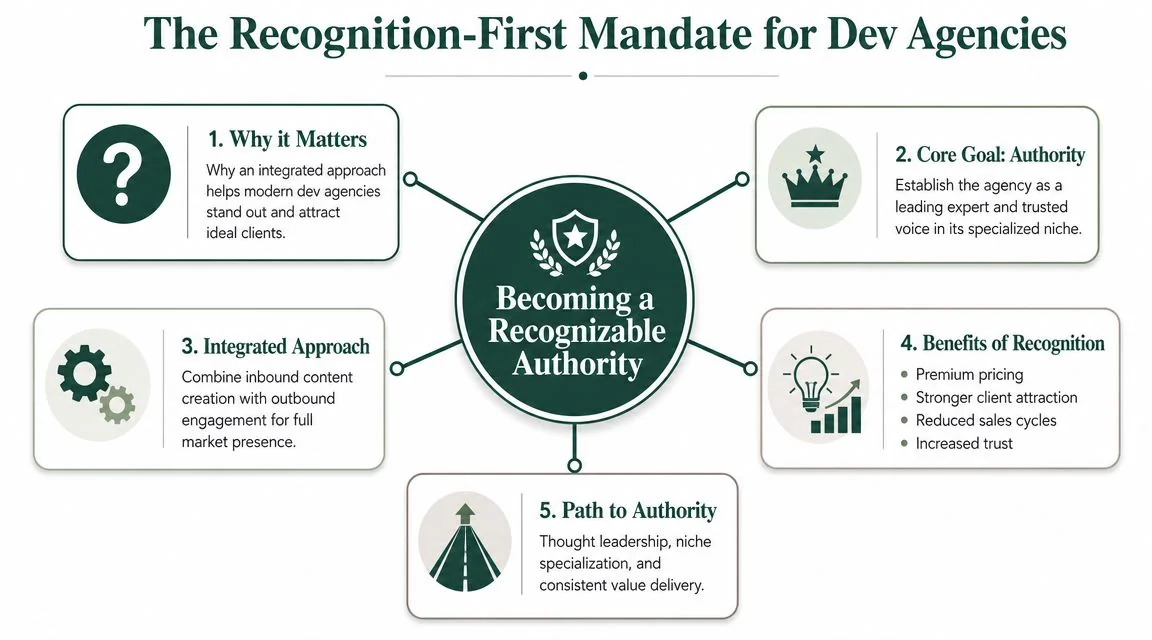
For a dev agency, recognition is often the difference between being treated like a commodity shop and being treated like a specialist. If your agency builds platforms for healthtech, logistics, fintech compliance, or embedded systems, buyers don’t want generic competence. They want visible proof that you’ve solved adjacent problems and understand their constraints.
Why visibility now changes outbound economics
Cold outreach to people who have never heard of you runs under 1% reply rates. Once target accounts already recognize the agency from LinkedIn, content, and AI citations, the replies we see across 300+ dev-agency campaigns run 5 to 10%. That’s not a marginal improvement. It changes the entire economics of outbound. Gartner’s finding that 73% of buyers avoid irrelevant outreach is the underlying mechanism: recognition is what makes outreach feel relevant rather than intrusive.
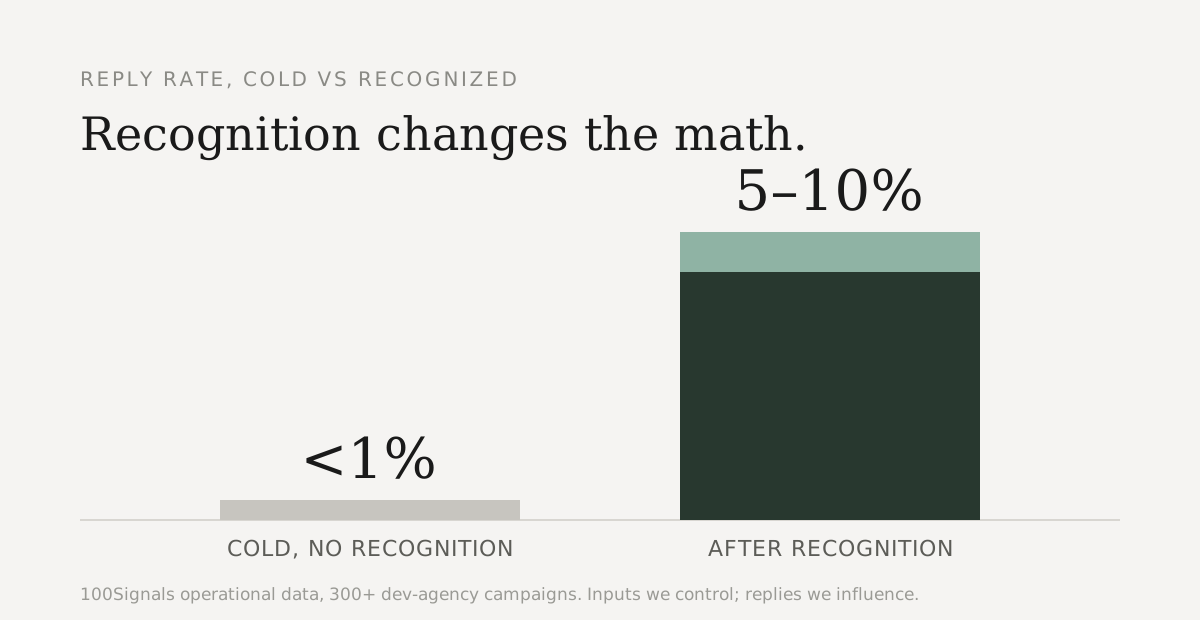
Inbound is no longer just “publish content and wait.” It’s the layer that makes later outbound feel familiar instead of intrusive.
A founder usually sees this in a simple pattern:
| Prospect state before outreach | Likely reaction to outbound |
|---|---|
| Never heard of you | Ignores, deletes, or parks the message |
| Saw your brand in search or AI answers | Recognizes the name and reads with context |
| Read niche content tied to their problem | More willing to reply or forward internally |
That sequence matters more in agency sales because buyers aren’t just assessing product features. They’re assessing risk. A strong technical article under a named architect, a niche landing page with clear positioning, and visible relevance in search reduce perceived risk before a conversation starts.
What recognition-first actually looks like
Recognition-first doesn’t mean broad “thought leadership.” It means being visibly associated with one commercially useful problem set.
A good setup usually includes:
- Niche-specific authority pages that describe who you serve, what systems you build, and where you fit.
- Technical articles with attributed expertise so buyers see depth, not generic content operations.
- Consistent visibility in search, AI summaries, and LinkedIn so your name appears more than once before outreach lands.
Buyers rarely reply because the email was clever. They reply because the sender already looks credible.
Most agencies publish broad content for traffic and run outbound against a separate account list. Those activities don’t reinforce each other. The better model is tighter. Build recognition around the exact market you plan to contact, then use outreach to turn familiarity into meetings.
A 90-Day Integrated Go-to-Market Sequence
The fastest way to waste outbound budget is to start outreach before the market can place your name. For dev agencies, the sequence matters more than channel mix. Visibility first. Outbound second.
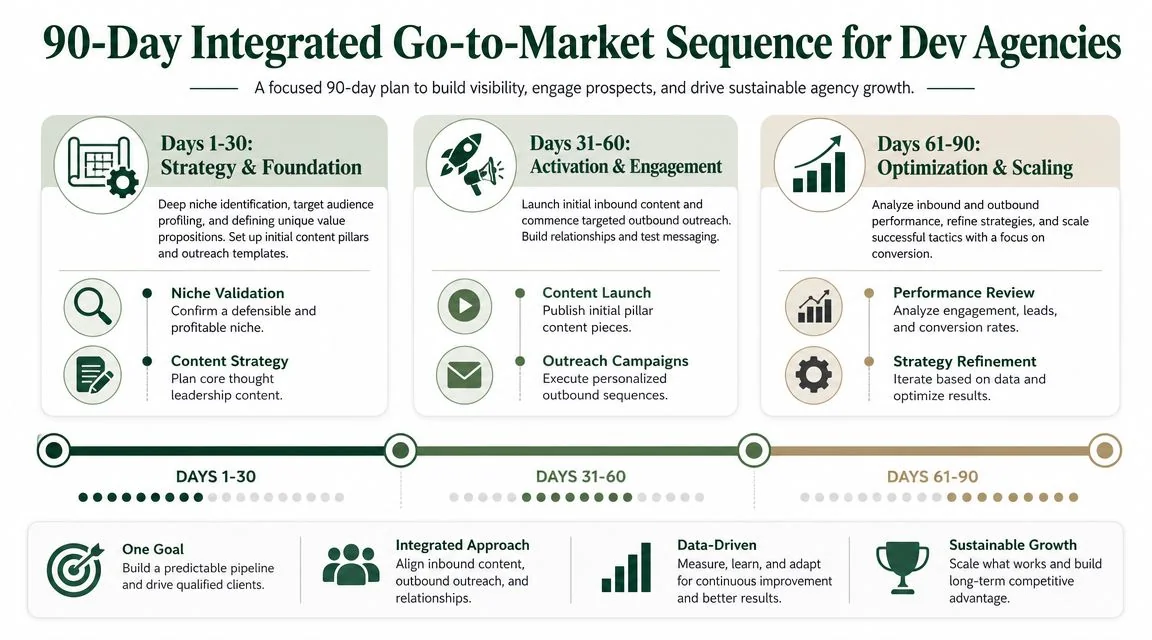
A simple framing for this is a unified approach to GTM strategy. For dev agencies, unified means the content plan, target account list, messaging, and follow-up rules all point at the same niche. If those pieces drift, reply rates fall and sales cycles get longer because buyers have to work out your relevance themselves.
Days 1 to 30 with strategy and foundation
Pick one niche. Not a broad category like “SaaS” or “healthcare.” Pick a commercial problem set where your team already has delivery proof, useful expertise, and enough market demand to support focused outreach.
Then build the account map around that choice. A practical model is one primary motion, one supporting motion, and stakeholder coverage across each target account. Agency deals usually need multiple internal supporters before they move, so a single-contact list is weak from the start.
Use the first 30 days to produce four operating assets:
| Asset | What it changes |
|---|---|
| Niche positioning statement | Gives every page, email, and call the same market language |
| Target account list | Keeps sales and marketing focused on the same buying universe |
| Stakeholder map per account | Reflects how technical agency purchases actually get approved |
| Core authority topics | Defines the proof your outreach will point prospects toward |
This month is also where leadership should decide who owns execution. If the agency lacks the internal capacity to run list building, content production, and outbound operations in parallel, a sales and marketing outsourcing model for B2B growth teams can close the gap faster than hiring piecemeal.
By day 30, the team should be able to answer three questions without hesitation. Who are we targeting? What specific problem are we known for? Which proof assets are missing right now?
Days 31 to 60 with visibility and activation
Month two is for publishing the assets that make outbound easier to believe. At this stage, sequencing pays off. Outreach sent after relevant pages are live, indexed, shared, and cited in AI answers converts better than outreach sent against an empty brand footprint.
Start with assets tied directly to sales conversations:
- Niche service pages that show fit in plain language
- Technical articles with real practitioner depth and named attribution
- Case summaries or proof pages that show similar systems, constraints, or outcomes
Keep the scope tight. One strong page for a real buyer problem beats five broad articles written for traffic. In agency sales, relevance does more pipeline work than volume.
I have seen this pattern repeatedly in dev agency programs, having run marketing inside agencies like Brainhub and across 300+ campaigns for dev and IT firms. When outbound starts after buyers can find a credible niche page, a technical article, and at least one piece of proof, reply quality improves because the prospect is evaluating an already legible firm, not a stranger making claims.
This is also the point to prepare outbound messaging and test it lightly. Send low-volume campaigns to a small slice of accounts. Use the live assets in one-to-one follow-up. Watch where prospects click, what they ignore, and which pages sales uses in conversations.
A short walkthrough often helps teams align on execution details before launch:
Days 61 to 90 with sequenced outreach
Month three is for scale, but controlled scale. Outreach should start with the accounts that already showed some signal. Page visits, LinkedIn engagement, repeat site sessions, and direct interaction with your team all count. Those accounts are not warm in the classic demand gen sense, but they are far more likely to reply than a cold list that has never seen your name.
Run outreach in four layers:
- Prioritize recognized accounts that engaged with content or visited high-intent pages.
- Expand into untouched accounts with the same niche message and the same supporting proof.
- Review account activity weekly and change priority based on replies, visits, and stakeholder engagement.
- Work across the buying group until you have coverage from the people who can influence technical, budget, and delivery risk.
The mistake here is obvious and expensive. Agencies send generic sequences to hundreds of contacts, then judge outbound as a channel. The fundamental issue is sequencing. Outbound without prior recognition has to create credibility from zero, and that is much harder in services than in lower-risk product sales.
Execution rule: Start outbound after the market can verify your relevance in search, on your site, and through attributed expertise.
By day 90, the goal is not perfection. The goal is a repeatable system with enough signal to improve. You should know which niche pages support meetings, which messages get forwarded internally, which accounts need more visibility before outreach, and where your team is losing momentum between first response and qualified opportunity.
Required Assets and Tooling for Execution
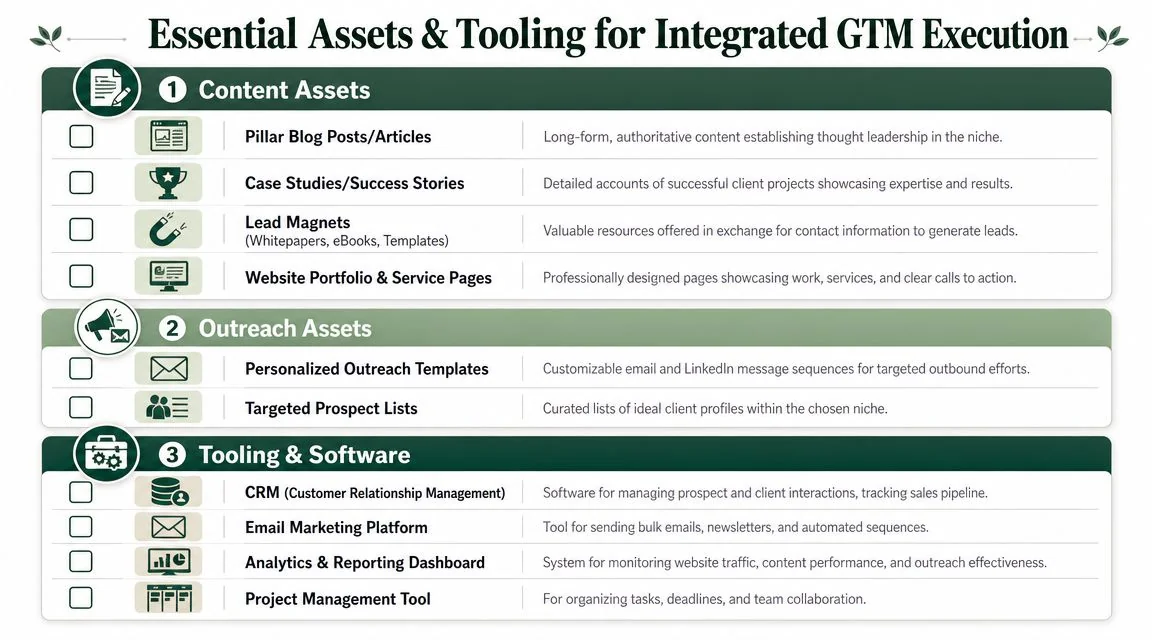
A recognition-first model fails when the team confuses activity with assets. You don’t need “more marketing.” You need a small set of deliverables that can survive scrutiny from a technical buyer.
The minimum build list
For most agencies, the required stack is straightforward:
| Asset type | Minimum useful version |
|---|---|
| Niche landing pages | One page per target vertical or problem cluster |
| Technical authority content | Deep articles attributed to a named practitioner |
| Outreach sequences | Email and LinkedIn messages tied to niche pain and proof |
| Target account map | Accounts with stakeholder coverage, notes, and priority |
| CRM reporting | Basic stage tracking across lead, meeting, opportunity, and customer |
The difference between generic and useful content is attribution and specificity. A broad article on “digital transformation” doesn’t help an engineering director decide whether your team understands platform modernization in their sector. A deep article with a named solution architect often does.
What content must do for outbound
Content in this model isn’t there to farm traffic. It’s there to answer the silent question every prospect has after receiving an email: “Why should I believe these people can solve this?”
That means your content should do at least one of these jobs well:
- Prove niche fit through language the buyer already uses.
- Demonstrate technical depth with clear architecture, process, or delivery reasoning.
- Reduce commercial risk by showing relevant project patterns or decision logic.
A practical build often includes HubSpot or Pipedrive for CRM, a sending platform that supports sequence management, LinkedIn for account research, and a simple analytics layer to track which pages influence meetings. Some agencies build this in-house. Others use external support. One example is sales and marketing outsourcing for specialized B2B teams, where the work spans niche positioning, authority content, and outbound execution in one system.
Tooling should support prioritization, not volume
The wrong tooling setup pushes teams toward quantity. The right setup makes it easier to spot which accounts are warm, which assets are getting used in live deals, and where handoffs break.
Generic blogs create noise. Specific assets create sales context.
For agency CEOs, that’s the practical test. If an asset can’t help a rep start, continue, or close a conversation inside a target niche, it probably doesn’t belong in the first 90 days.
The New Scorecard Metrics and Benchmarks
The usual scorecard for inbounding and outbounding rewards siloed output. Marketing reports traffic and MQLs. Sales reports opens, replies, and meetings. Neither view tells you whether your market recognizes your agency or whether that recognition is improving pipeline quality.
The better scorecard tracks authority plus conversion behavior.
What to measure instead
Use leading indicators that show whether the recognition layer is making outreach easier and sales motion more efficient.
| Metric Focus | Siloed Model (Lagging Indicator) | Integrated Model (Leading Indicator) |
|---|---|---|
| Website performance | Raw traffic | Visits to niche pages from target accounts |
| Content performance | Pageviews | Whether sales uses the asset in live conversations |
| Outbound performance | Open rate alone | Reply rate split between cold and pre-warmed accounts |
| Lead management | MQL count | Speed of qualification and account progression |
| Brand presence | None | Branded search and AI citation visibility |
| Sales outcome | Closed deals only | Movement from engaged account to meeting to opportunity |
A dev agency can get “good” top-of-funnel numbers while still being invisible to the accounts it wants. A niche authority model should create signs of recognition before revenue shows up in closed-won reporting.
The ACV guardrail most agencies ignore
There is also a financial constraint that should shape your mix. It’s a well-accepted go-to-market principle: if ACV is below $10,000, labor-heavy outbound is usually uneconomical, and past product-market fit, a large share of marketing effort should shift to inbound. Dev agencies typically sell engagements at $100,000 and above, so outbound can pay here. But even at those deal sizes, outbound works better when the agency is already visible in the buyer’s research process. Recognition isn’t a luxury. It’s what makes the unit economics stack up.
A CEO should ask three blunt questions every month:
- Are target accounts showing signs of recognition before outreach?
- Are pre-warmed accounts replying at a meaningfully different rate than cold ones?
- Does our average deal size justify the manual effort we’re putting into outbound?
If you can’t answer those, you’re probably measuring motion instead of pipeline mechanics.
Common Failure Points and How to Fix Them
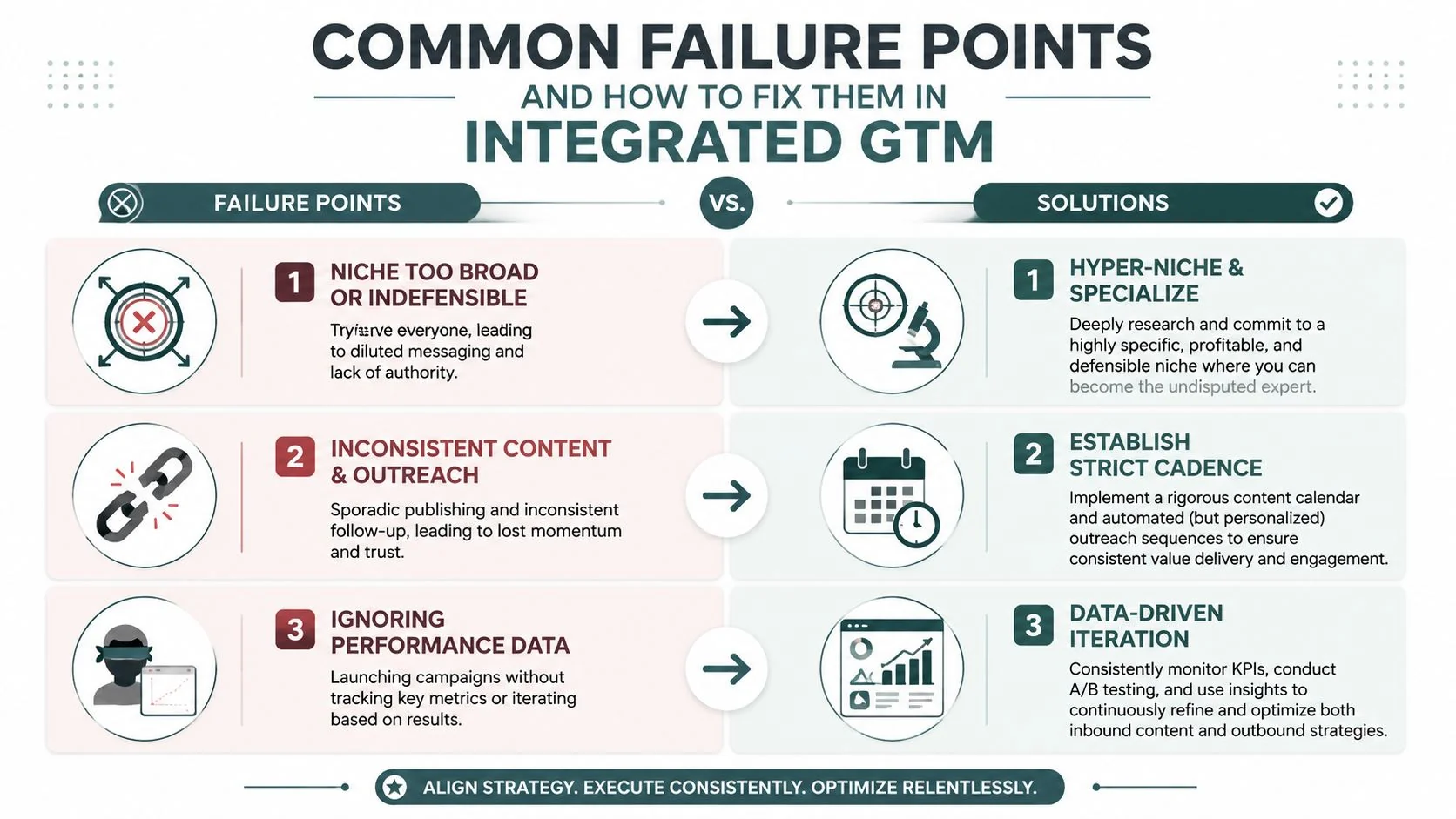
Integrated inbound and outbound usually break at the handoff points. The strategy is sound. The problem is that agencies keep treating authority-building and outreach as parallel workstreams, then wonder why outbound underperforms.
The niche is too broad
A dev agency cannot be memorable to the right buyer if it claims expertise in five markets at once. “We build for SaaS, fintech, healthcare, logistics, and enterprise modernization” reads like a capability deck, not a market position. Inbound gets watered down. Outbound gets ignored because every message sounds like it could have come from any nearshore shop with a list and an email tool.
The fix is to choose a narrower commercial wedge and stay with it long enough to earn recognition. Pick the segment where you already have proof, a clear problem statement, and deal sizes that justify focus. Then make that wedge visible everywhere prospects check you. Service pages, case studies, founder posts, technical explainers, comparison content, and AI-citable answers should all reinforce the same claim.
Agencies usually resist this because they fear excluding revenue. In practice, the opposite happens. A tighter niche raises reply quality, shortens qualification, and gives outbound reps language that sounds informed instead of generic.
The content reads like marketing, not operator insight
This failure is expensive because it hides in plain sight. The team publishes consistently, traffic inches up, and leadership assumes inbound is working. Then prospects click from an outbound message to your site and see polished copy with no evidence that your team has solved the problem before.
Technical buyers look for signs of execution. They want to see constraints, architecture decisions, migration risks, build-versus-buy calls, team composition, and the trade-offs behind delivery plans. If the content only talks about innovation, scalability, and business value, it does not build trust. It weakens the outbound sequence that follows.
The fix is simple but harder than hiring a freelance writer. Put practitioners into the draft. Name the problem. Explain where projects fail. Show what your team would do first, what you would avoid, and why. A short teardown from an engineering lead usually outperforms a polished thought-leadership post because it gives buyers something they can verify.
Authority content should make outreach easier. If it does not give a prospect a reason to believe your agency understands their situation, it is not an asset. It is overhead.
Sales and marketing optimize different systems
This is the operating failure I see most often in agencies above the founder-led stage. Marketing is rewarded for activity. Sales is rewarded for meetings. Neither side owns account progression from recognition to conversation.
The result is predictable. Marketing brings in form fills and site visits from mixed-fit accounts. Sales works the loudest leads, ignores weak context, and asks for more outbound volume. Leadership sees motion in every dashboard and still cannot explain why pipeline quality is inconsistent.
The fix is shared account logic. One target list. One definition of intent. One rule set for what happens after an account visits key pages, engages with a niche asset, or responds to outreach. Operatix reports that inbound SDRs handle about 15 leads per day on average in its SDR benchmark summary. That makes prioritization the constraint, not lead capture.
For dev agencies, this matters more than process hygiene. If inbound has not created recognition first, outbound reps spend their time trying to manufacture trust from zero. If inbound has done its job, outbound becomes follow-up on existing awareness. That is the sequence that improves pipeline efficiency. It is also the difference between sounding like another vendor and getting treated like a known specialist.
Inbounding and Outbounding: Common Questions
What is the difference between inbounding and outbounding?
Inbounding attracts buyers who are already looking for a solution: they find you through search, AI answers, or content. Outbounding initiates contact with buyers before they raise their hand. The distinction is who starts the interaction. For dev agencies, the useful question is not which one works better, but in what sequence they reinforce each other.
Should a software development agency do inbound or outbound first?
Build inbound visibility first. Get niche pages live, get technical content indexed, and build enough presence in search and AI answers that a prospect can verify your credibility before your team reaches out. Then run outbound against that foundation. Outreach to accounts that already recognize your name runs at meaningfully higher reply rates than cold outreach into a blank market.
Why do cold emails fail for dev agencies?
Cold emails fail because dev agency deals are high-trust, long-cycle purchases. A buyer who has never heard of you has no reason to reply to a stranger asking for 20 minutes. According to Gartner’s 2024 buyer survey, 73% of B2B buyers actively avoid suppliers who send irrelevant outreach. Without prior recognition, every email reads as irrelevant. The fix is not better copy. It is building recognition before the email goes out.
How long before an integrated inbound and outbound system produces pipeline?
Expect 60 to 90 days before the system produces meaningful pipeline signal. The first 30 days go to niche selection, asset production, and list building. Days 31 to 60 are visibility and activation: getting pages live, getting content indexed, testing outreach lightly. Outbound at scale starts in month three against accounts that have already had some contact with your brand. Early replies arrive around day 30 to 45. Qualified meetings typically compound from month two onward.
Do you need inbound before outbound?
Not strictly, but skipping it is expensive. Cold outbound alone can work for agencies with strong referral networks or a recognizable brand. For most dev agencies entering a new niche, starting outbound before inbound is live means paying full cost for outreach that lands on accounts with no frame of reference. The 2 to 3x conversion lift from prior brand engagement (Demandbase, 2026) is the clearest case for sequencing. Build the recognition layer first. It makes every outbound dollar work harder.