How to Get Google Rankings That Actually Move Pipeline
How to get Google rankings for software dev agencies: niche validation, content, technical SEO, links, and a 90-day sequence to move from invisible to page one.
How to get Google rankings is not a content volume problem. For a software development agency, it’s a niche-ownership problem. Google has treated links as a core ranking signal since PageRank, and its guidance still frames links as one way it discovers and assesses pages, which means rankings have always depended on relevance plus authority, not keyword stuffing alone (Semrush on Google keyword ranking).
If you’re running a 100 to 500 person agency, generic blog output won’t move pipeline. Buyers don’t shortlist the firm with the most articles, they shortlist the firm that looks inevitable in one specific vertical, on Google and in AI assistants. That’s the game now, and it starts with choosing one defensible market and building enough authority that your page becomes the obvious answer.
Why Most Agencies Never Break Past Page Two
Most agencies don’t have a ranking problem, they have a positioning problem. They chase three or more verticals, publish broad thought leadership, and then act surprised when the site never becomes the obvious result for any one buyer question. That’s backward. Rankings are the output of owned territory, not the cause of it.
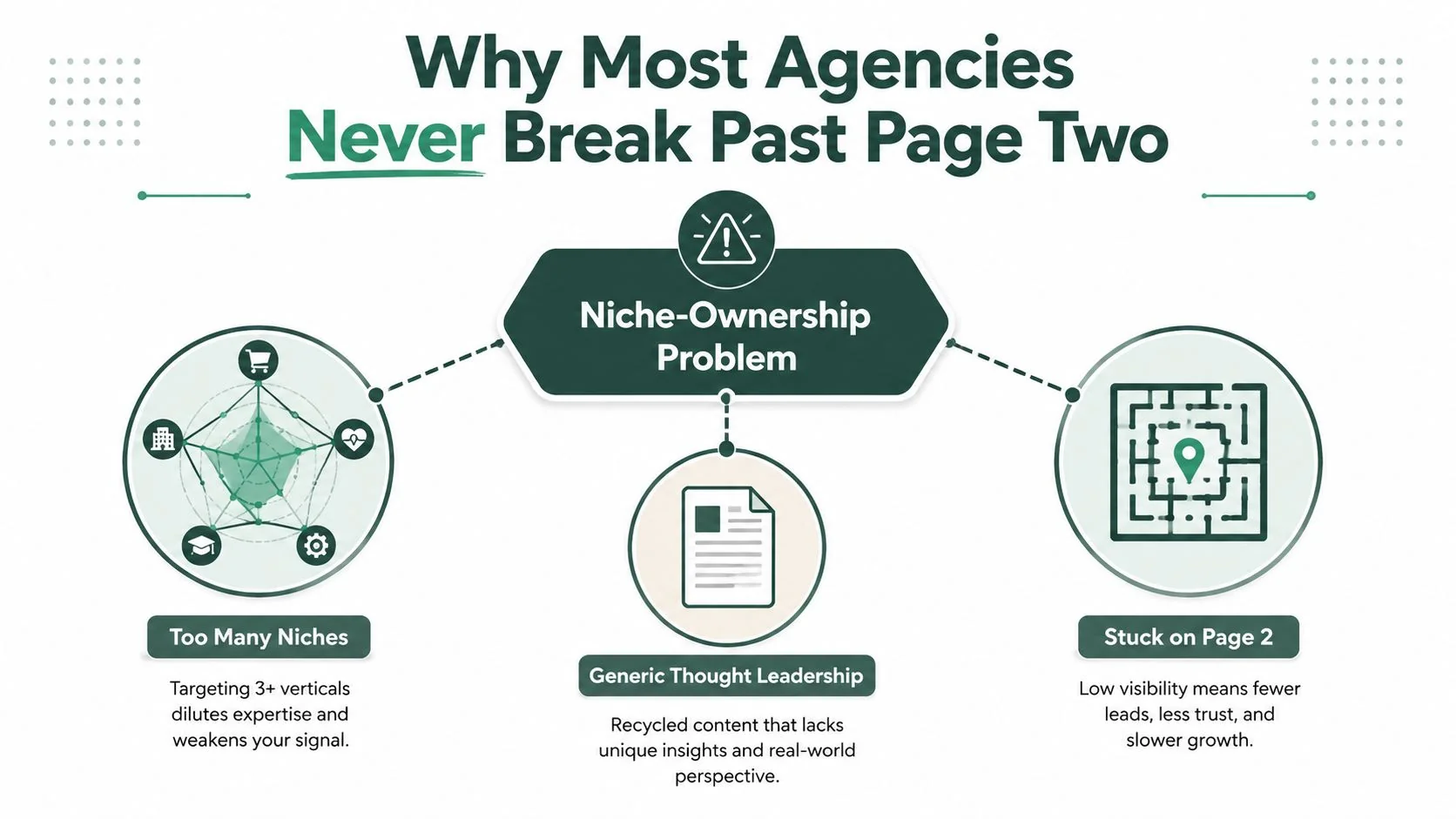
The agencies that hold page one in both Google and AI answers usually share three traits. First, niche specialization. Second, technical-depth content written by named practitioners. Third, structured data and clean page architecture that make the site legible to crawlers and models. Google’s Search Essentials is blunt about crawlable links and best practices for images, videos, structured data, and JavaScript, because if the machine can’t understand the page, it can’t rank it well (Google Search Essentials).
Practical rule: if a buyer can’t tell what vertical you own within five seconds, Google probably can’t either.
This is why broad SEO advice underperforms for agencies. A CTO doesn’t want a vendor who “does software development for everyone.” They want the agency that already feels embedded in their category. That’s the pipeline effect, because an agency that owns one vertical becomes the obvious choice on a buyer’s day-one shortlist, where 95% of B2B purchases originate according to the brief’s verified data, and that shortlist advantage matters more than another traffic spike.
If you want a useful companion on the paid-vs-organic tradeoff, the clearest breakdown I’ve seen is Ilias Ism on SEO vs ads. The point isn’t to choose one channel forever. The point is to stop using ads as a substitute for authority.
Pick One Niche You Can Actually Own
Pick the smallest defensible niche, not the broadest one that sounds impressive in a partner meeting. For a dev agency, a niche becomes worth owning only when the math supports it. The 100Signals benchmark uses 40+ pre-mapped segments and 1,700+ agencies as the backdrop for this kind of validation, which is the right way to think about the problem, because most agencies never check whether a vertical is winnable.
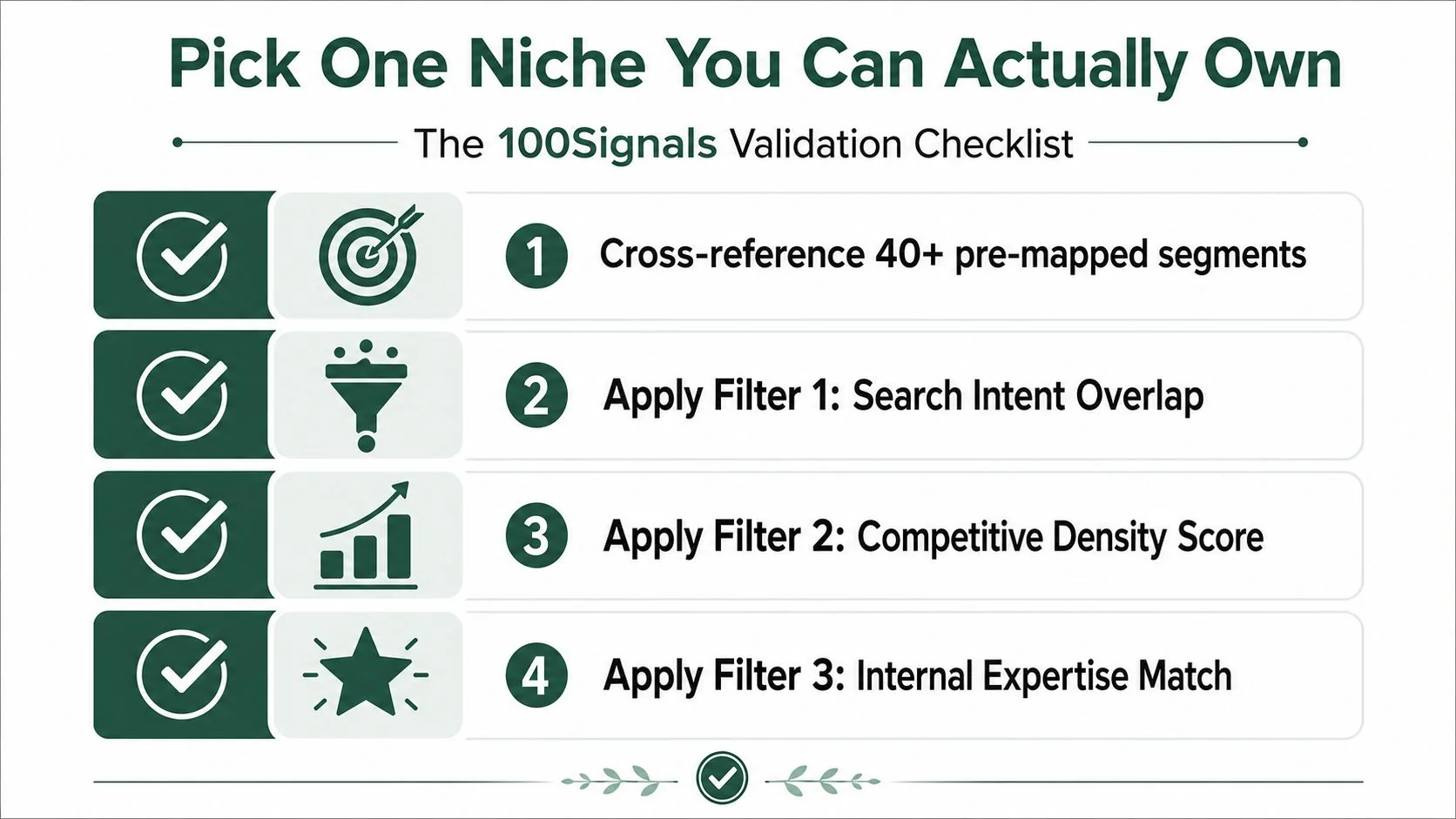
Use three filters, not gut feel
Start with buyer density. You want a vertical with enough software vendors that outsource work, but not so many that every agency already claims it. Then check competitive density, meaning how many agencies already have credible niche proof in that space. Finally, test AI citability, which is whether ChatGPT, Claude, or Perplexity already recommend anyone there. That three-part screen is what separates a niche from a dead end.
A vertical with 200 to 500 mapped target accounts, fewer than three credible incumbent agencies, and zero AI citations today is a niche you can own. A vertical with 5,000+ accounts and ten incumbent agencies is a content treadmill. The second one feels safer. It isn’t. It’s crowded, and you’ll spend months publishing into noise.
| Niche profile | Signal | What it means |
|---|---|---|
| Ownable | 200 to 500 target accounts, fewer than three credible agencies, no AI citations | Buildable territory |
| Crowded | 5,000+ accounts, many incumbent agencies, visible AI recommendations | Slow, expensive fight |
| Undefined | Vague buyer set, weak search intent, no clear buying committee | Hard to message, harder to rank |
The contrarian move is to choose the niche that looks small. In agency work, exclusive territory is usually granted by geography and specialization together, so the smallest-looking niche can be the highest-ROI one because you’re not just competing for clicks, you’re competing for category ownership.
If you want a faster way to pressure-test this, use the page at validate niches with SEO data and score one vertical this week. Don’t pick a niche you “like.” Pick one you can defend.
Decision rule: if you can’t map the buyer list, the incumbent agencies, and the AI visibility in one page, you don’t know the niche well enough to build around it.
Map Keywords as a Cluster, Not a List
Keyword research is architecture work. Agencies that treat it like a spreadsheet end up with isolated posts. Agencies that treat it like a cluster build topical gravity around a service line inside one niche. Google’s own SEO Starter Guide says content should be easy to read, unique, up to date, and helpful, reliable, and people-first, with long pages broken into sections and headings (Google SEO Starter Guide). That’s not decorative advice. It’s the structure that lets a page rank.
Build one pillar, then surround it
Your cluster starts with one pillar page per service offering inside the chosen niche, like custom EHR integration services or HIPAA-compliant patient portal development. Around that page, publish supporting posts that answer the questions buyers ask before they ever talk to sales. The point is not volume. The point is coverage.
Use the reverse-engineering method before you write. Pull the top 5 ranking URLs for the pillar keyword, map their titles, H1s, opening paragraphs, and topic coverage into a spreadsheet, and score the gap. That’s the cleanest way to see what search intent you’re missing. A separate guide notes that a relevance and topic-coverage score helps compare your page against competitors and exposes content gaps before you publish or update a page (YouTube guide on ranking analysis).
The fastest win comes from existing pages. Mine Google Search Console for queries with at least 100 impressions already sitting in positions 10 to 20, because Google has already connected that page with a query but it hasn’t broken into page one yet (Sunil Pratap Singh on how to rank in Google). Then fix the title tag, deepen the page, add an internal link from a stronger page, and rewrite the intro as a 30 to 60 word answer capsule. That move usually beats publishing ten new posts because you’re improving a page Google already trusts.
Operating rule: never write a new post before checking whether an existing one is sitting one edit away from page one.
For agencies, this cluster model matters because it turns one vertical into a defendable library. One pillar, 8 to 12 support pages, and a few well-placed internal links do more for niche authority than a pile of generic posts ever will.
Write Content That Google and ChatGPT Both Cite
Content now has two audiences, and they want the same thing: a direct answer from a named expert. The brief’s verified data says 47% of enterprise buyers start vendor research with AI assistants, ahead of 43% using Google Search, so this isn’t hypothetical. If your page can’t be cited by both, it’s underbuilt for the current buyer journey.
The answer capsule wins because it’s usable
The format that keeps showing up in cited AI answers is a 30 to 60 word answer capsule placed directly under the heading. The brief says that format appears in 72.4% of posts ChatGPT cites, which tells you exactly how to structure the page. Don’t bury the answer in paragraph four. Put it first, then expand.
For a dev agency, every pillar and support post should have a byline with the architect or engineering lead’s name, a LinkedIn link, and a short credential line. That’s not fluff. It’s how you make the content attributable. The brief’s verified data says expert-attributed content is 3.2x more likely to be cited by LLMs than brand-authored content. If you want AI visibility, you need a real human responsible for the answer.
| Content element | What to do | Why it matters |
|---|---|---|
| Answer capsule | 30 to 60 words under the heading | Easier for Google and AI tools to quote |
| Named author | Practitioner byline with LinkedIn | Stronger attribution and trust |
| Heading structure | Clear H2s and short sections | Easier to scan, index, and cite |
| Freshness | Update examples and recommendations | Better alignment with Google’s people-first guidance |
For a practical AI-visibility guide, I’d pair this with the guide to winning AI Overviews, because the mechanics line up with what you’re trying to do here. The important thing is simple. Write for quotability, not for word count.
Google’s SEO Starter Guide still matters too. It wants pages that are easy to read, unique, up to date, and people-first, broken into paragraphs and sections with descriptive headings (Google SEO Starter Guide). That’s the baseline. If your content looks like an anonymous rewrite of the top results, it won’t win in Google or in AI answers.
The Technical SEO Audit You Can Finish in One Week
Technical SEO is not the strategy, but if it’s broken, the strategy crawls at half speed. A dev agency should treat this as a one-week audit, not a quarter-long initiative. Google Search Essentials says pages need crawlable links and best practices for images, videos, structured data, and JavaScript so Google can understand the site (Google Search Essentials). If you skip that, your niche pages stay invisible.
Fix the basics in priority order
Start with Core Web Vitals, because slow interactivity hurts both users and crawlers. Google’s “good” INP threshold is 200ms or less, and anything slower needs attention. Then audit internal linking so every cluster page is reachable from the homepage or pillar page. If it isn’t linked, don’t expect reliable discovery.
The next layer is structured data. Use Organization, Article, FAQ, and BreadcrumbList schema where relevant. Then clean up metadata. Search Engine Land recommends keeping the title tag under 60 characters, the meta description under 155 characters, placing the keyword near the front, and making both unique (Search Engine Land ranking guide). That’s not optional polish. It’s how you stop your own pages from cannibalizing each other in the SERP.
| Audit item | Target | Reason |
|---|---|---|
| INP | 200ms or less | Better interactivity and crawl experience |
| Title tag | Under 60 characters | Cleaner SERP display |
| Meta description | Under 155 characters | Better snippet control |
| Internal links | Crawlable from key pages | Faster discovery and indexing |
| Structured data | Organization, Article, FAQ, BreadcrumbList | Clearer page context |
If you want a hands-on audit path for a WordPress stack, the performance audit for WordPress is a sensible reference point. Use it to hand a developer a Monday ticket list and get a real fix by Friday.
The structural rule often overlooked is this, each section should function like a mini entry point with clear headings and short paragraphs. That’s what makes snippets possible. It also makes your service pages easier to repurpose across search, AI answers, and sales follow-up.
Build Authority With Entity Mentions, Not Link Spam
Old-school link chasing is the wrong game for agency authority. The more useful signal is entity mention quality, especially on platforms buyers already trust. The brief’s verified data says entity mentions on G2, Clutch, and Reddit correlate with AI citation probability at 0.664, while raw backlinks sit at 0.218. That’s a strong enough gap to change your playbook.
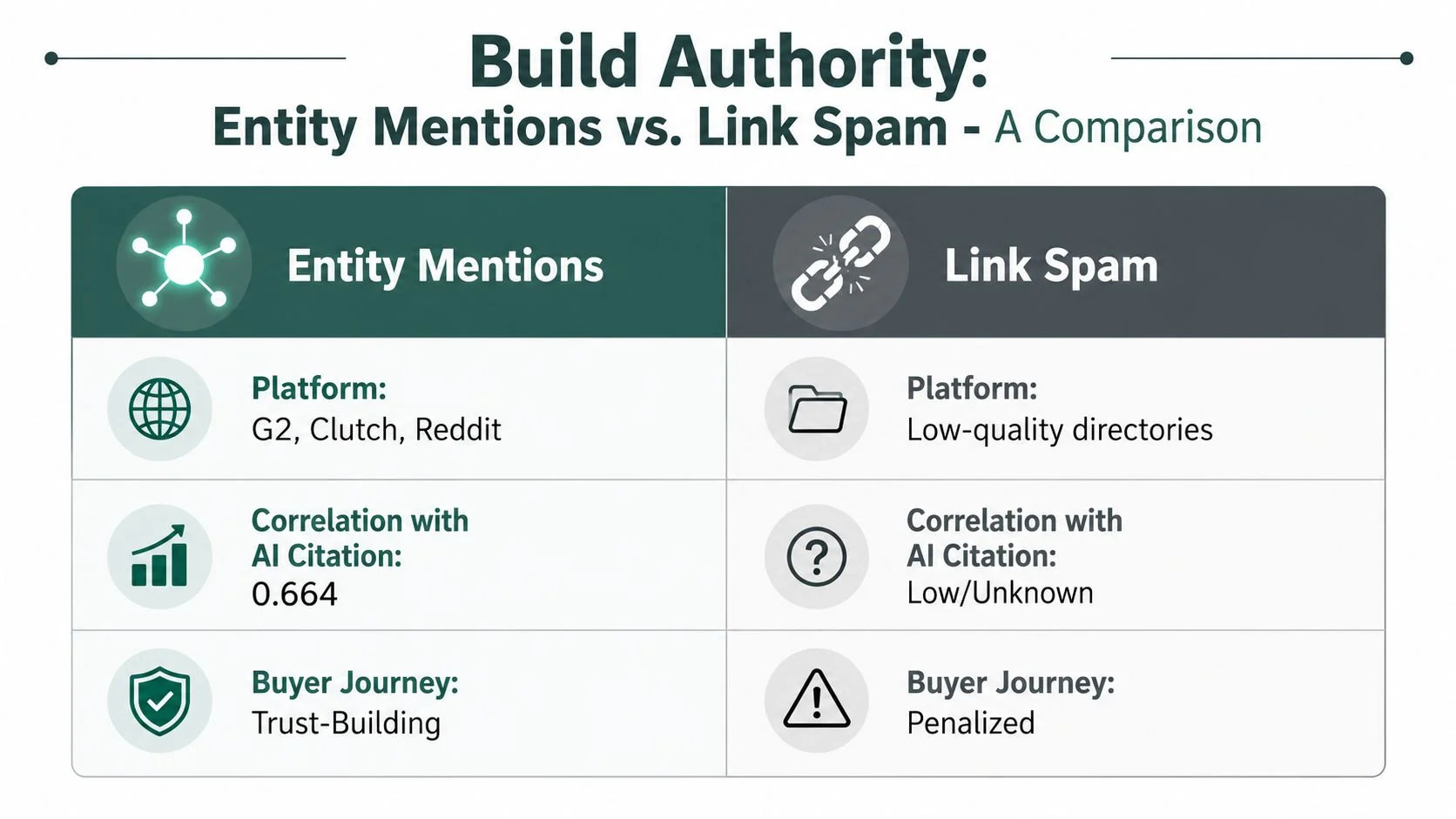
Use trust platforms before you buy links
A 100 to 500 person dev agency should not be buying guest posts on random DR-40 blogs. It should be claiming and completing its G2 and Clutch profiles, building a review-request workflow into project closeout, and earning mentions where target buyers already ask for recommendations. That’s operational authority, not link theater.
| Authority move | Execution | Outcome |
|---|---|---|
| Review profiles | Complete G2 and Clutch profiles | Stronger vendor credibility |
| Review workflow | Ask after project delivery | Reliable social proof stream |
| Community mentions | Show up in relevant Reddit threads | Visible buyer trust signals |
| Original research | Publish one or two data pieces per quarter | More cite-worthy assets |
A quarterly original-research drop gives you something journalists and niche publications can reference. Pitch it to two trade publications in the vertical you chose. That creates the kind of named entity presence Google and AI systems can recognize without you paying for low-quality placements.
The local angle matters too. If you serve one metro, the fastest gains come from completing and verifying the Google Business Profile, posting photos, responding to every review, and keeping the profile accurate. Google’s local guidance is explicit about those operational details, and that’s because local visibility is won through entity hygiene, not a content calendar (Google Business Profile help).
The agency lesson is simple. Don’t chase more links. Build more proof that your firm exists, is trusted, and belongs to one category.
Measure What Matters and Run the 90-Day Sequence
Most agencies measure rankings too late. By the time pipeline appears, you’ve already lost weeks guessing whether the work is working. Start with the signals that move first. The most reliable leading indicator is branded search volume in Google Search Console, because buyers who already know your name are closer to meeting readiness than anonymous visitors.
Measure in the right order
Google Search Console can show ranking data for up to 1,000 queries, and it reports a site’s average position across queries, which is the right way to watch visibility over time instead of checking one-off incognito results (Semrush on Google keyword ranking). Search results vary by location, device, and personalization, so single checks mislead you. Use the aggregate.
The second metric is average position across target queries. The third is AI citation presence, checked weekly with the exact buyer questions your prospects ask in ChatGPT, Claude, and Perplexity. The fourth is reply rate on outbound, because once prospects have already seen your brand cited, the conversation changes fast.
| Metric | What to track | Why it matters |
|---|---|---|
| Branded search | Search Console branded queries | Early proof demand is building |
| Average position | Query groups in Search Console | Shows whether visibility is improving |
| AI citations | Weekly buyer-question prompts | Confirms dual-channel authority |
| Reply rate | Cold, warm, intent-based outbound | Shows whether visibility is converting |
Practical rule: if your branded search isn’t moving, don’t celebrate rankings yet. You may have traffic, but you don’t have remembered demand.
Run the 90-day sequence
Days 1 to 30 go to niche validation, cluster architecture, and the technical audit. Days 31 to 60 go to publishing the pillar page, four supporting posts, and the first wave of entity mentions. Days 61 to 90 go to measurement, iteration, and outbound against the 200 to 500 mapped target accounts and 1,000 to 5,000 contacts in your chosen niche.
If you need a broader operating system behind that sequence, explore 100Signals’ resources. Use it as a reference point, not a crutch. The point is to line up search, AI visibility, and outreach so the same niche shows up everywhere a buyer looks.
A dev agency that owns one niche in both Google and AI is no longer competing on price or pitch deck. It shows up before the RFP exists, which is the only ranking outcome that really matters for pipeline.