Data for SEO: Build Authority and Predictable Pipeline
How software dev agency CEOs use search-demand evidence to validate niches, weigh competitors, and build pipeline that is not referral-dependent.
Most agencies use SEO data to explain the past. That’s the wrong job. 95% of B2B deals are won by a vendor already on the buyer’s day-one shortlist, according to 6sense’s B2B Buyer Experience Report. If you sell software development services into a niche, that isn’t a reporting story. It’s a market access story: you either build the visibility that puts you on that shortlist before the buying conversation starts, or you compete for scraps.
For a dev agency CEO, data for SEO only matters if it helps answer three hard questions. Which niche has enough search demand to justify focused positioning. Which competitors are weaker than they look. Which signals correlate with qualified meetings, not vanity traffic. Everything else is dashboard decoration.
Stop Reporting on SEO Data and Start Using It
Most agencies still treat SEO data as a rearview mirror. Rankings went up. Traffic went up. Impressions went up. None of that tells you whether you’re becoming the obvious choice in a market segment.

The core use of search-demand data is allocation. It tells you where buyer intent already exists, where attention is concentrated, and where authority can compound into pipeline. Since the top of Google captures a disproportionate share of clicks, bad market selection is expensive. You can publish for months, rank for the wrong terms, and still produce no sales movement.
That’s why “more SEO” is the wrong target. The target is a defensible go-to-market position. If you need a basic refresher on how search works before getting into systems thinking, this short guide on how to increase website visibility with SEO is useful. But the jump from visibility to pipeline happens when you stop asking “How are we ranking?” and start asking “Where can we own intent that maps to a service line?”
Practical rule: If a metric doesn’t change targeting, positioning, content priorities, or outreach sequencing, it’s reporting noise.
What founders usually get wrong
Founders who think like engineers often reject SEO because they’ve only seen weak versions of it. They’ve seen reports full of branded clicks, blog traffic from irrelevant geographies, and monthly ranking snapshots with no sales context. Their skepticism is rational. But the referral channel they’re relying on instead is also cracking: client discovery through networking dropped from 73% in 2022 to 58% in 2025, and discovery through past relationships fell from 67% to 48% over the same period, according to RSW/US New Year Outlook data via Neuwark. Passive pipeline management is now actively risky.
The mistake isn’t skepticism. The mistake is assuming SEO data itself is soft. It isn’t. The soft part is how teams use it.
What data should do instead
Used well, this data becomes a targeting input for niche authority. It helps you decide whether to build pages for a vertical, whether to produce comparison content, whether to invest in technical cleanup first, and whether a search position is likely to produce the kind of buyer who books a serious call instead of a low-fit inquiry.
For agencies in crowded segments, that shift matters more than incremental traffic growth. A small improvement in the right search cluster can change lead flow because buyers compare providers through search before they ever reply to outbound. That is why this belongs in GTM planning, not just marketing reporting.
The Three Tiers of Data That Matter for Agencies
Most SEO discussions flatten all data into one pile. That’s sloppy. For a software agency, different data types answer different business questions. Baseline data tells you what happened on your own site. Competitive data tells you where the market is already placing trust. Strategic data tells you whether a niche is worth pursuing and how to frame your offer.
The tier model
| Data Tier | Primary Sources | Key Metrics | Strategic Use Case for an Agency |
|---|---|---|---|
| Performance data | Google Search Console, GA4, CRM, call or form attribution systems | Queries, landing pages, click patterns, conversion paths, assisted conversions | Establish a baseline for what content attracts attention and whether that attention produces qualified opportunities |
| Competitive data | Semrush, Ahrefs, manual SERP review, review platforms | Topic coverage, page types, ranking patterns, SERP features, competitor content gaps | Identify who owns the niche conversation and where incumbents are weak or unfocused |
| Strategic data | SERP intent analysis, business data consistency checks, AI visibility monitoring, internal sales feedback | Commercial intent patterns, local/entity consistency, citation presence, topic fit by vertical | Decide whether to enter a niche, how to message the offer, and what authority assets will support pipeline |
Tier one is operational. Useful, but limited. It answers “What did our site do?” If your blog post drew visits but didn’t create meetings, performance data will show activity without explaining strategic fit.
Tier two is where agencies usually find their advantage. Competitive data shows whether search is dominated by giant publishers, thin affiliate pages, local competitors, or service firms like yours. That distinction changes the whole play. Ranking against informational media sites requires one content strategy. Beating underdeveloped agency pages requires another.
Why the third tier matters most
Tier three gets closest to revenue. It asks whether search behavior, SERP shape, and adjacent discovery systems point to a market you can realistically own. This is also where most generic SEO programs fall apart because they stop at rankings.
For agencies that care about AI-era discovery as well as Google, tooling is shifting. If you’re evaluating platforms designed to track both search and assistant-level presence, a specialized AI visibility platform for agencies can be useful as a complementary layer, not a replacement for core SEO measurement.
If your data stack can’t tell you which topics build market recognition in a niche, it can’t guide GTM. It can only describe publishing activity.
How to use the tiers in practice
Don’t give all three tiers equal weight. Performance data is necessary but easiest to overvalue because it’s first-party and neatly packaged. Strategic data is messier, but it’s where real decisions live. A CEO deciding whether to target fintech product modernization or healthcare platform engineering doesn’t need another traffic chart. They need evidence about demand concentration, competitor weakness, and intent quality.
That’s the difference between an SEO program and a niche acquisition strategy.
Sourcing and Validating High-Integrity Data
Most bad SEO decisions come from bad inputs dressed up as precise dashboards. A clean chart can still rest on weak assumptions, stale keyword databases, or single-tool estimates treated as truth.
If you want search intelligence that can survive executive scrutiny, build it more like a product analytics pipeline and less like a monthly marketing export.
| Data source type | What it’s good for | Where it breaks down |
|---|---|---|
| Off-the-shelf dashboards (Semrush, Ahrefs) | Spot checks, single-niche research, one-time competitor scans | Can’t automate across 10+ niches; manual exports, no repeatable scoring |
| First-party (Search Console, GA4) | What your own site did; conversion path analysis | Gives no view of competitor activity or market demand outside your domain |
| API access (DataForSEO and equivalents) | Repeatable analysis across many niches, geographies, and competitor sets; feeds internal scoring models | Requires engineering setup; raw data needs normalization and intent mapping |
| Manual SERP review | Validating intent, spotting SERP feature shifts, assessing page quality | Doesn’t scale; should confirm API findings, not replace them |
Why API access matters
Off-the-shelf dashboards are fine for spot checks. They break when you need repeatable analysis across many niches, service pages, geographies, and competitor sets. DataForSEO says its APIs are used by 750+ SEO software companies and agencies and that it aggregates data from search engines, marketplaces, review platforms, and billions of websites on its company site. For an engineering-led agency, that matters because APIs let you automate rank tracking, SERP monitoring, and visibility analysis without manual exports.
That changes the economics of research. Instead of one strategist pulling ad hoc reports, your team can build reusable scoring models for niche validation, service-page opportunity mapping, and share-of-voice monitoring.
If you’re thinking about this operationally, not just tactically, this piece on scalable SEO data pipelines is a useful reference because it frames SEO analytics as infrastructure rather than reporting.
A validation process that doesn’t fall apart
One source is rarely enough. Search data is noisy, SERPs change, and tools use different methods. Treat every platform as a partial view.
A workable validation process looks like this:
- Pull raw query and landing page data from first-party systems such as Search Console and analytics.
- Compare external keyword and SERP datasets across your research tools or APIs.
- Review the live search results manually for your highest-value clusters.
- Normalize naming and intent categories so service terms, industries, and geographies are comparable.
- Store the cleaned dataset in a system your team can query repeatedly.
What to validate first
Four areas break most often. Search demand tools can overstate or flatten true volume, so compare multiple sources and check whether live SERPs show sustained content competition. Intent classification mixes informational and commercial terms, so review what page types actually rank and map them to your service-line goals. Competitive strength at the domain level can hide page-level weakness, so evaluate the actual pages ranking rather than the site’s aggregate authority score. And visibility reporting can look stable while SERP features silently change click opportunity, so monitor page types, local packs, AI overviews, and comparison modules in the results alongside rank data.
Build a data asset you can query again in six months. If the work dies in a slide deck, you didn’t build an asset.
Where this becomes a GTM advantage
Once your data is structured, you can score niches against the same criteria every time. That’s where SEO stops being artisanal. It becomes a consistent decision system.
This is also one of the few places where a specialized agency can justify deeper process. 100Signals does this for software agency founders: the output isn’t a generic report, it’s a market-selection model that feeds qualified meetings and builds presence in a niche the agency can defensibly own. That distinction matters because consistent criteria produce consistent decisions, not one-off research projects.
How to Interpret Data Without Lying to Yourself
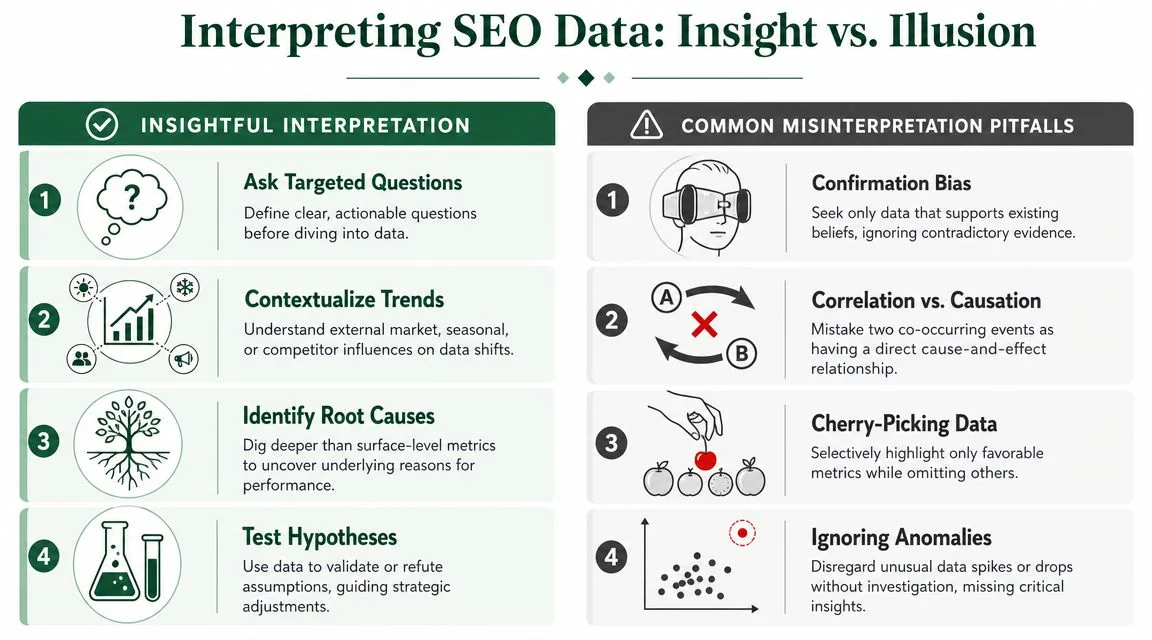
Teams often don’t suffer from a lack of SEO data. They suffer from false confidence. They collect more charts than they can defend, then tell themselves a clean narrative about growth.
Search Engine Land made the right point when it warned that impressions, CTR, seasonality, and GA4 attribution can distort interpretation, and that “more data is not always a good thing” if the question isn’t defined first in its piece on SEO data pitfalls and accurate analysis. That warning matters more now because buyer journeys are fragmented across search, AI surfaces, direct visits, referrals, and outbound follow-up.
The common self-deceptions
A rise in impressions can mean broader keyword exposure. It can also mean your page is being shown for low-fit queries that won’t produce pipeline. Better rankings can mean stronger authority. They can also mean the SERP shifted temporarily or intent changed.
Founders should push their teams on one point. What decision does this metric justify?
If the answer is vague, the metric is probably being used as theater.
Better questions produce better analysis
Use SEO data to test explicit hypotheses. For example:
| Weak question | Better question |
|---|---|
| Are we getting more organic traffic? | Are the pages built for our target niche generating more qualified inquiries than broad thought-leadership pages? |
| Did rankings improve? | Did rankings improve on commercially relevant topics where buyers compare vendors or evaluate capability? |
| Is branded search growing? | Are more prospects arriving with prior awareness that shortens trust-building in sales conversations? |
| Did the new content work? | Did the content improve visibility in a service and vertical combination we actually want to own? |
The second version forces accountability. It ties search performance to a business thesis, not to generic activity.
Good interpretation starts before analysis. Define the decision first, then collect only the evidence needed to support or reject it.
What a defensible framework looks like
A defensible measurement framework connects search visibility to revenue without pretending SEO gets sole credit. That means combining search data with CRM stage movement, self-reported attribution, sales call notes, and account-level engagement patterns.
It also means accepting ambiguity where ambiguity exists. Multi-touch journeys are normal in B2B services. A prospect might discover your agency through Google, revisit directly, ask an AI assistant for vendor options, then reply to outbound two weeks later. Trying to assign all credit to the last click is convenient and wrong.
Signals worth trusting more
Some signals tend to hold up better than isolated traffic spikes:
- Sustained visibility in a tightly defined niche rather than broad traffic growth
- Improved performance on commercial page types instead of informational posts alone
- Sales-team recognition of recurring themes in inbound conversations
- Repeated appearance across buyer research surfaces including search results, directory profiles, and AI-driven discovery tools
That’s less satisfying than a single vanity metric. It’s also much closer to truth.
A Repeatable Workflow for Niche Validation
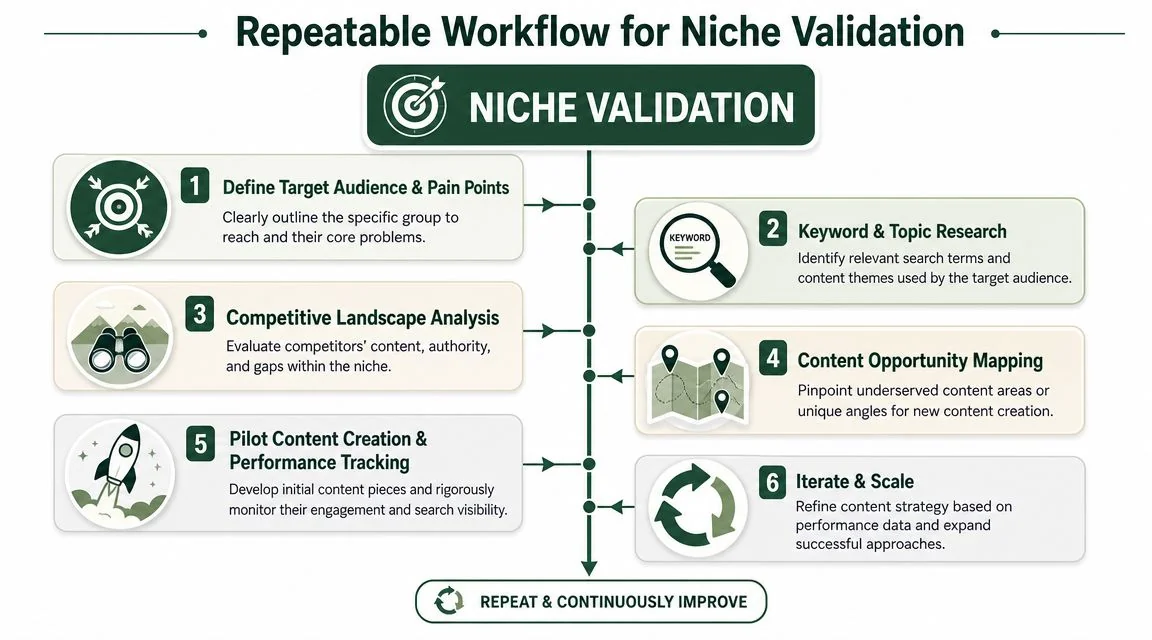
A niche shouldn’t become your positioning because it sounds attractive or because one salesperson closed a good deal there. It should earn focus through evidence. Data for SEO is useful here because it lets you test whether a segment has visible demand, beatable competition, and enough technical weakness to enter with conviction.
Start with search market shape
Begin with service plus industry combinations your agency could credibly own. Don’t start with abstract sectors. Start with explicit buyer problems mapped to what you sell.
Review whether the search results indicate active evaluation behavior. Are buyers seeing service pages, comparison pages, location pages, case-study style content, or broad educational posts? That distinction tells you whether the market searches for vendors directly or only for adjacent information.
For a deeper model of how to score that decision, this guide to agency niche validation is relevant because it treats authority-building as a measurable market-entry problem rather than a branding exercise.
Score the competitive field
The next step is not “Who ranks?” It’s “Who deserves to rank?” There’s a difference.
Use a scorecard like this:
| Criterion | What to inspect | What it tells you |
|---|---|---|
| SERP composition | Agencies, publishers, directories, review sites, local packs | Whether the niche is service-led or information-led |
| Offer clarity | Do top-ranking agencies clearly state who they serve and what they do | Whether incumbents have strong positioning or generic service copy |
| Content depth | Are pages thin, outdated, or interchangeable | Whether better authority content can displace current results |
| Conversion readiness | Do ranking pages support contact, proof, and buyer progression | Whether search winners are also likely to win pipeline |
| Technical quality | Loading, interactivity, layout stability | Whether performance weaknesses create an opening |
Use technical weakness as an entry point
Many firms leave opportunity on the table. Google’s Core Web Vitals thresholds include Largest Contentful Paint at 2.5 seconds or less, Interaction to Next Paint at 200 milliseconds or less, and Cumulative Layout Shift at 0.1 or less, as outlined in Semrush’s technical SEO guidance. If competing pages in your target niche consistently miss these thresholds, they may be holding rankings with authority despite a weak page experience.
That creates an opening for an agency with a disciplined web stack, better information architecture, and cleaner service-page execution.
This walkthrough gives a practical visual for how to think about process before scale:
Turn observations into a go or no-go decision
Don’t end with a research folder. End with a decision framework.
Use a simple sequence:
- Define the niche thesis. State the service, segment, and buyer problem in one sentence.
- Map core search clusters. Group terms by commercial evaluation, problem discovery, and vendor comparison.
- Review live SERPs manually. Identify the page types and players dominating each cluster.
- Audit top competitors. Check offer specificity, proof, technical execution, and content quality.
- Assess entry feasibility. Determine whether your team can produce pages and supporting content that are clearly better.
- Commit or reject. If the niche lacks intent, fit, or realistic entry points, drop it.
A niche is valid when search demand, ranking weakness, and service credibility line up. Miss one, and the program becomes content production without strategic payoff.
What this changes for a dev agency CEO
This workflow reduces positioning risk. Instead of betting on a niche based on internal opinion, you’re testing external evidence. Instead of asking your team to “do SEO for healthcare” or “go after fintech,” you’re asking whether the market presents conditions where authority can convert into qualified meetings.
That’s the practical value of data for SEO. It lowers the cost of being wrong before you invest in months of content, design, and sales alignment.
Connecting Search Authority to Your Pipeline
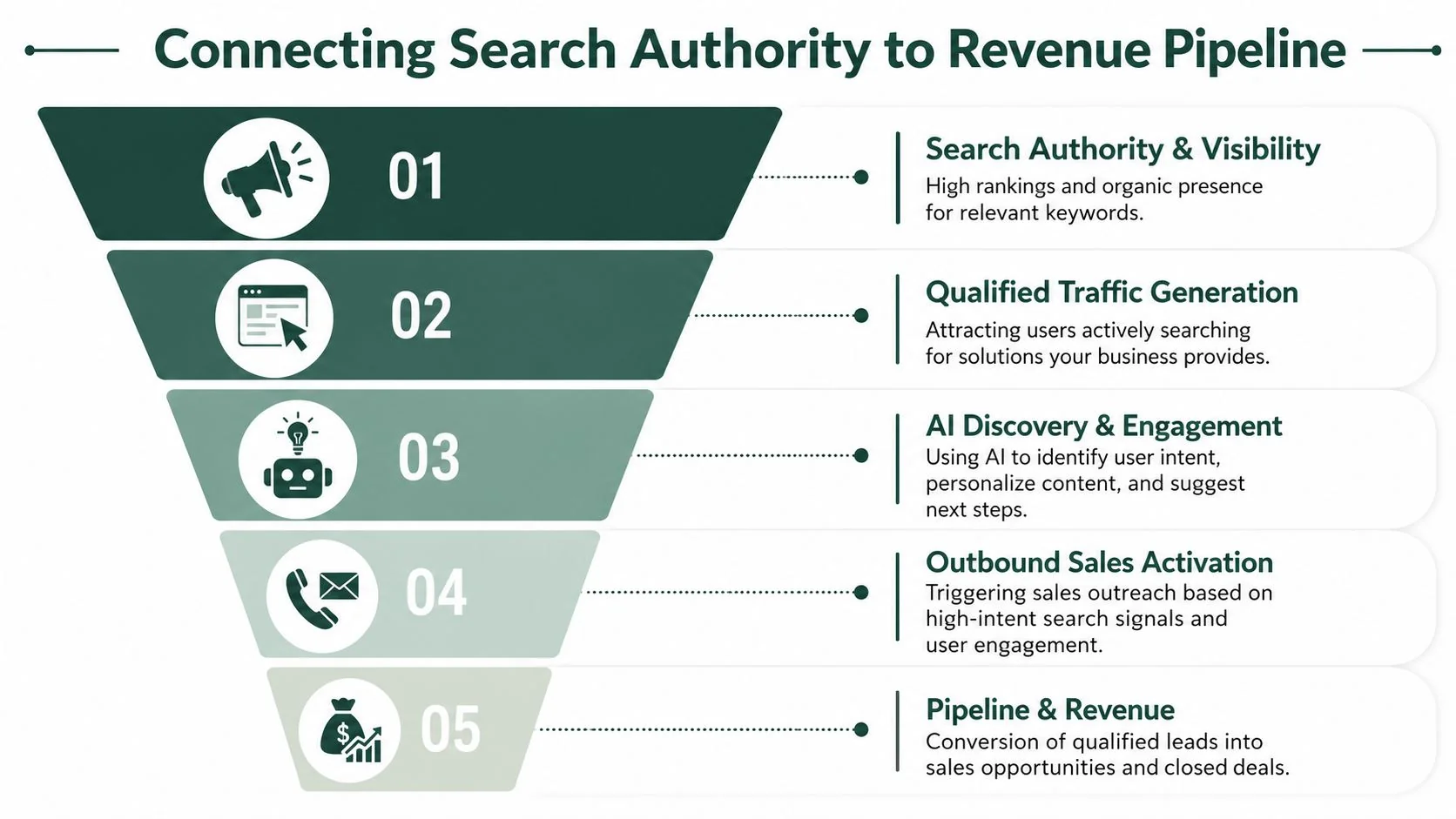
Search authority matters because it changes how prospects interpret your agency before sales ever speaks to them. The highest-value outcome isn’t traffic. It’s pre-sold credibility.
Authority compounds across channels
When your agency ranks for niche service queries, publishes clear service pages, and maintains consistent business information, you don’t just improve Google visibility. You improve discoverability across the wider research layer buyers use.
That includes AI-driven discovery. Data Axle’s 2025 guidance argues that inconsistent business data across platforms hurts both local SEO and AI-driven discovery, and frames centralized data management as preparation for AI search in its piece on bad data and its local SEO and AI search impact. For agencies, this means directory hygiene, service descriptions, location data, and business identity aren’t clerical tasks. They’re trust signals.
What this means for outbound and pipeline
A prospect who has already seen your agency in search, in a category page, or in an AI-generated recommendation does not respond like a cold account. Recognition changes the conversation. Outbound performs better when it activates existing awareness instead of introducing a stranger.
That’s why search authority shouldn’t sit in a silo. It should feed targeting, sales messaging, and follow-up strategy. If your organic presence shows that buyers associate you with a niche capability, your outbound team can write from that position instead of manufacturing credibility from scratch.
A broader view of Demand generation for software agencies makes this point well. Search, AI visibility, and outbound are more effective when they reinforce the same market position.
The operational standard
To connect search authority to pipeline, keep the operating model simple:
| Input | Operational question | Pipeline implication |
|---|---|---|
| Search authority | Are we visible where niche buyers research vendors? | Higher chance of entering shortlists before direct contact |
| Business data consistency | Are our identity and service signals aligned across platforms? | Better trust and discoverability across search and AI surfaces |
| Commercial content | Do our pages help buyers compare, evaluate, and contact us? | Stronger conversion from awareness to qualified inquiry |
| Sales activation | Is outbound referencing the authority we’ve already built? | Warmer conversations and better meeting quality |
SEO data only becomes valuable when it tells you where to build authority that sales can cash in. For a software development agency, that means using search intelligence to choose a niche, expose weak competitors, publish assets that match buyer research behavior, and support outreach with visible proof. That’s how demand evidence stops being a reporting layer and starts becoming a pipeline system.
On Monday: pick one niche you have closed work in, run a manual SERP review for three to five service-plus-vertical keyword combinations, and assess what types of pages are ranking. Agency pages, publishers, directories, or nothing at all. That single observation tells you more about market entry feasibility than a month of dashboard reports.
If the SERP shows weak or absent agency pages, that’s your opening. Score it against the criteria in this piece, decide whether your team can produce clearly better content, and set a three-month commitment or kill the niche thesis. The data doesn’t make the decision for you. It makes the decision cheaper to get right.